- Space Dirt
- Posts
- December's Space Dirt 🚀 (mid-month)

December was a big month for companies emerging from stealth. We have satellite security guards, AI factories that learn production lines in days, and construction companies designing with software speed. Meanwhile, funding stayed strong, and I highlighted a bunch of agreements and partnerships.
One thing I’ve noticed is that companies solving America's "we forgot how to build" problem are getting the checks. Whether it's cutting construction costs 50% with AI or capturing manufacturing knowledge before it retires with the respective workforce, investors are taking note. You’ll see some examples below.
In this issue:
5 Real Estate Highlights
6 Stealth Companies
16 Notable Fundings
8 Agreements & Partnerships
And some content that I think is worth your while.
Happy holidays!
-Erik
REAL ESTATE HIGHLIGHTS
Empower Semiconductor announced a major expansion of its global operations with the opening of its new headquarters in Milpitas, CA, and the establishment of a dedicated research and development (R&D) center in Munich, Germany. These strategic investments, following its successful series D financing round, are aimed at accelerating Empower’s technology lead and supporting a considerable increase in customer demand. (source: Empower Semiconductor)

Valstad leased space at Infinity Park at 11708 McAngus Rd, Del Valle, TX. (image: Lee & Associates)
Valstad Shipworks leased 63,191 SF at 11708 McAngus Rd, Del Valle, TX. (source: Me!)
Master Boat Builders announced plans to build a $60 million, 150,000 SF defense shipbuilding facility in Coden, AL, dedicated exclusively to government and defense programs. The 20-acre site (directly across Bayou Coden from the company's existing yard) will support 200 new jobs and enable serial production of steel and aluminum ships for Navy and Coast Guard programs, including the U.S. Navy's Landing Craft Utility (LCU) program through Master Boat's strategic outsourcing agreement with Austal USA. The facility will also pursue the Domestic Icebreaker program for the U.S. Coast Guard. Site clearing began last month, and construction is expected to take 18-24 months. (source: Marine Log)

Saronic’s shipyard expansion strengthens America’s shipbuilding industrial base and helps revive a vital industry that supports U.S. maritime leadership and national security. (image: Saronic)
Saronic announced a $300 million investment to expand its Franklin, Louisiana, shipyard — a major milestone in the company’s continued growth as a leader in autonomous shipbuilding. This investment will significantly increase production capacity for Saronic’s fleet of Autonomous Surface Vessels (ASVs), adding 1,500 skilled jobs and strengthening the Gulf Coast’s role in the future of American maritime innovation. Supported by close partnerships with Louisiana Economic Development, St. Mary Parish, and other state and local officials, Saronic is expanding its facility to meet surging demand for its autonomous ships. The company broke ground on the new construction project in November 2025, which will add more than 300,000 SF of new production capacity. The project is slated for completion by the end of 2026, with expanded operations coming online in early 2027. (source: Medium)
STEALTH NO MORE
Fortastra emerged from stealth with $8 million in seed funding led by Upfront Ventures to build autonomous security satellites that defend critical assets in orbit. The Torrance, CA-based company develops maneuverable escort satellites with high delta-v propulsion that can respond quickly to threats in space. The satellites are modular and designed for payload swaps across different mission profiles, featuring remote sensing, autonomous capabilities, and end effectors to handle third-party hardware in the vacuum of space. Mike Smayda is Founder and CEO (former SpaceX senior aerodynamics engineer for 5 years, working on landing rockets, Falcon components, and early Starship architecture; co-founded Hermeus hypersonic aircraft company, where he led systems engineering and served as Chief Product Officer, plus led customer engagement with defense and intelligence customers). Other investors include Generational Partners, Forward Deployed Venture Capital, Bloomberg Beta, and Wave Function Ventures. Fortastra is building a "physical AI stack" for precise rendezvous and proximity operations (RPO) and autonomous interventions. This is essentially a security detail for satellites that can approach, inspect, and, if necessary, engage threats to spacecraft. The near-term customer is the U.S. government, but the same physical AI capabilities required to defend satellites are also needed to build, service, and maintain infrastructure in orbit. The company will use funding to validate sensor hardware and build integrated software and autonomy models for reliable protect-and-defend maneuvers. (source: Payload Space and Nick Kim’s Substack)
Moonshot Space emerged from stealth with $12 million in funding (led by Angular Ventures, which includes a $1 million Israel Innovation Authority grant) to build an electromagnetic launcher capable of propelling payloads to hypersonic speeds of up to 8 km/second using electricity rather than chemical propellants. The Caesarea, Israel-based company (founded in 2024) is developing two applications: a scaled-down Mach 6 accelerator for hypersonic testing (multiple tests per day vs. current slow/expensive methods) and a full-scale orbital launcher for cargo resupply to space stations and satellites (raw materials, fuels, consumables). By removing onboard propellant, the system raises payload fraction from a typical 4% to over 45%. Founders are Hilla Haddad Chmelnik (CEO, former Director-General of the Israel Ministry of Science, Iron Dome development team member), Fred Simon (CTO, JFrog co-founder), and Shahar Bahiri (COO, Valerann co-founder). Moonshot signed preliminary agreements with D-Orbit and Orbit Fab for in-space refueling and servicing. The company plans to reach space within five years. (source: Payload Space)
Overview Energy emerged from stealth after successfully demonstrating power beaming from a moving aircraft to a ground receiver 5 kilometers (3 miles) below—the world's first airborne power beaming demonstration for space solar energy. The Ashburn, Virginia-based company plans to collect continuous sunlight in geosynchronous orbit and beam it to existing utility-scale solar farms on Earth using near-infrared lasers, allowing solar projects to generate power at night and operate 24/7. The system targets $60-$100 per megawatt-hour by 2035. Overview raised nearly $20 million across two seed rounds, led by Lowercarbon Capital, Prime Movers Lab, and Engine Ventures (with investors including Aurelia Institute, Earthrise Ventures, and EQT Foundation). Marc Berte is Founder and CEO. The company plans a low Earth orbit demonstration in 2028 and targets commercial operations in geosynchronous orbit by 2030 with the first megawatt transmission from space. The company spun out of Vast when Vast decided to focus on space stations. (source: PR Newswire and LinkedIn)
Matta emerged from stealth with $14 million in seed funding led by Lakestar to build "sentient factories" using AI. The University of Cambridge spinout (founded 2022) develops industrial AI that learns any production line within days and enables factories to see, understand, and improve themselves in real time. The system uses unsupervised and self-supervised computer vision to automate quality control, detect anomalies, perform measurements, diagnose root causes, and provide real-time corrective recommendations. Matta's plug-and-play system combines hardware, factory integration, AI research, and software, with most deployments becoming operational within hours after a short learning phase. The technology captures and scales tacit human knowledge (the engineer who hears a wobble, the operator who spots a flaw) and works across sectors, including electronics, automotive, defense, and apparel. Douglas Brion is Co-founder and CEO (PhD in deep learning-enabled control), Sebastian Pattinson is Co-founder and Associate Professor of Engineering at Cambridge's Institute for Manufacturing. Other investors include Giant Ventures (led pre-seed), RedSeed VC, InMotion Ventures, 1st Kind (Peugeot family), Unruly Capital, and Boost VC, plus grants from Innovate UK and Royal Academy of Engineering. Current customers include Caracol AM and Bowers & Wilkins. In one polymer manufacturing case, Matta achieved 99%+ defect-detection accuracy with just 10 minutes of data. The company has a waiting list of 300+ potential customers and completes a new installation every two weeks. (source: Tech.eu and LinkedIn)
Unlimited Industries emerged from stealth with $12 million in seed funding co-led by Andreessen Horowitz and CIV to build an AI-native, vertically integrated construction company. Other investors include Bessemer Venture Partners, Hustle Fund, Earthshot Ventures, MCJ, and Liquid 2 Ventures. The San Francisco-based startup develops AI technology that generates and evaluates hundreds of thousands of design configurations in parallel to identify optimal layouts for cost, safety, and performance before construction begins. The company designs and builds $100M+ data centers, power plants, and mining facilities, compressing engineering timelines from months to days with AI-driven optimization. Alex Modon is Co-founder and CEO (a multidisciplinary engineer and repeat founder); Tara Viswanathan and Jordan Stern are Co-founders (previously built and scaled Rupa Health from zero to millions in revenue before its 2024 acquisition). On recent projects, Unlimited reduced pre-construction engineering from six months to a few weeks and identified designs that cut projected capital costs by over 50%. The company offers fixed-price contracts instead of traditional cost-plus models, eliminating misaligned incentives where contractors profit from delays. Unlimited aims to "automate construction end-to-end and ensure a future of radical physical abundance" where cities rise at the push of a button. (source: LinkedIn and Forbes)
Neon Aero emerged from stealth with the launch of its website and company LinkedIn page. The aerospace startup acquired Rotating Composite Technologies (RCT), a leader in composite propeller design and manufacturing (founded in 2008, known for supplying Sikorsky's X2 and S-97 Raider pusher propellers), and rebranded it as Neon Propellers. Neon relocated RCT from its 7,500 SF headquarters to a state-of-the-art 52,000 SF factory, including over 11,000 SF of cleanroom space to enable large-volume production. The company also established its corporate headquarters and systems development center in a 10,000 SF R&D space in Irvine, California. Neon's systems team is focused on products integrating software, electrical, and mechanical systems, with its first offering being an electro-mechanical actuation platform. Dave Dennison is President and CEO (former VP of Engineering at Archer, Triumph, and Bell Flight). Neon's mission is to bring speed, scale, and innovation to aerospace through extreme customer collaboration, transparency, and engineering excellence. (source: LinkedIn and Neon Aero)
PRESENTED BY COFACTR
The Pentagon's new "Arsenal of Freedom" strategy is clear: rapid iteration and mass deployment win. But while engineering teams have digitized design and accelerated prototyping, component sourcing is still stuck in the analog age.
The result? Advanced satellite constellations and hypersonic programs sitting idle, waiting on basic parts. The innovators who win the next generation of defense contracts won't just be the fastest engineers—they'll be the ones who finally modernized their supply chain.
NOTABLE FUNDINGS
Castelion announced it raised $350 million in Series B financing, positioning the company to directly advance a top Pentagon modernization priority: hypersonic munitions production at scale. The Series B round was led by Altimeter Capital and Lightspeed Venture Partners, with participation from Lavrock Ventures, Andreessen Horowitz, General Catalyst, First In, Space VC, Cantos, BlueYard, Avenir, Champion Hill, and Interlagos. The capital raise supports critical technical and manufacturing milestones: integrating Castelion’s first hypersonic weapon, Blackbeard, with U.S. Army and U.S. Navy operational platforms; building its production and final-assembly facility, Project Ranger; and multi-service platform testing in 2026. (source: Castelion)
K2 Space has raised a $250 million in Series C at a $3 billion valuation. This round comes on the heels of $500 million in signed contracts across commercial and U.S. government customers. The Series C is led by Redpoint, with participation from T. Rowe Price, Hedosophia, Altimeter, Lightspeed, Alpine Space Ventures, and others. (source: LinkedIn)
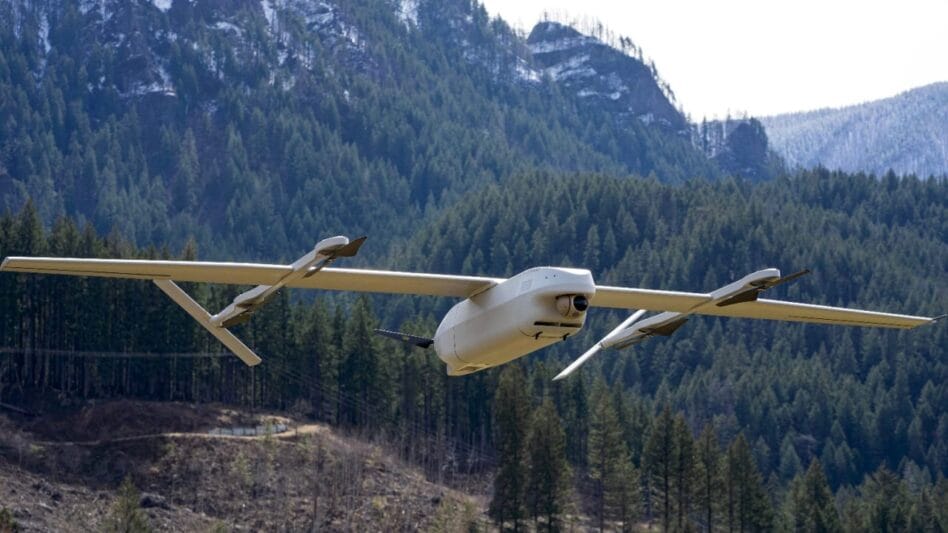
Heven’s Z1 hydrogen-powered drone. (image: Heven AeroTech)
Heven AeroTech raised $100 million in Series B funding at a $1 billion valuation (unicorn status), led by IonQ, with participation from Texas Venture Partners. The Sterling, VA-based company (founded in 2019, formerly Heven Drones) builds hydrogen-fuel-cell-powered drones with extended endurance. The funding will expand U.S. manufacturing capacity, build out hydrogen generation and logistics infrastructure for persistent forward operations, and create a quantum-focused engineering division to develop quantum-secure communications, alternative positioning/navigation systems for GPS-denied environments, and AI-powered autonomous operations. (source: Tectonic)
Antares announced a $96 million Series B. The round was led by Shine Capital with participation from Alt Capital, Caffeinated, Fifty Three Stations, Industrious Industries, and others. From the CEO, Jordan Bramble: “This capital allows us to move with the speed and discipline required to deliver something America hasn’t done in a very long time: design, build, and test nuclear reactors within a few years—not decades… This capital will be deployed toward hardware, subsystem testing, fuel fabrication, manufacturing, and the infrastructure required to turn on a reactor and lay the foundation for even more progress to come.” (source: Antares)

Vatn Systems, a defense technology company building autonomous underwater vehicles (AUVs) for the US military, allied nations, and commercial customers, today announced it has raised $60 million in Series A funding, bringing total funding to $76.5 million. The round was led by BVVC, with participation from new investors such as Hanwha, Geodesic Capital, Airbus Ventures, Dauntless Ventures, Trousdale Ventures, and Veteran Ventures Capital. Major existing investors also participated in the round, including DYNE Ventures, Propeller Ventures, Decisive Point Ventures, SAIC Ventures, Centre Street Partners, Cubit Capital, and Lockheed Martin Ventures. "Demand for affordable, scalable autonomous systems in undersea environments is accelerating rapidly. This funding strengthens our position as the leader in deployable AUV technology and enables us to expand our team, accelerate R&D, and scale manufacturing to capture this growing demand and win critical contracts both domestically and internationally," said Nelson Mills, co-founder and CEO of Vatn Systems. (source: PR Newswire)
Fabric8Labs closed a $50 million round to expand its electrochemical additive manufacturing platform. The round was led by New Enterprise Associates and Intel Capital. Existing investors: Lam Capital, TDK Ventures, SE Ventures. And the new investors were: Marunouchi Innovation Partners, SK hynix, Ericsson Ventures, Masco Corporation Ventures, and Toppan Global Venture Partners. Fabric8Labs is building a patented Electrochemical Additive Manufacturing (ECAM) platform enabling ultra-precise metal components critical for modern electronics and semiconductor systems.
(source: LinkedIn)
Haven Energy has raised a total of $40 million in equity and debt financing to install more solar panels in California homes with batteries that it leases, betting the strategy best addresses the hurdles facing the residential solar sector. The round includes equity led by Giant Ventures and a debt facility provided by Turtle Hill Capital, with additional equity participation from California Infrastructure and Economic Development Bank, Comcast Ventures, Lerer Hippeau, Carnrite Ventures, and Chaac Ventures. (source: The Wall St Journal)
pH7 Technologies raised $25.6 million in Series B (expected to exceed $30 million across subsequent closings), led by Fine Structure Ventures, with BHP Ventures joining as strategic investor. Other investors include Energy & Environment Investment (EEI), Siteground, Gaingels Fund, Calm Venture, TDK Ventures, Pangaea Ventures, Rhapsody Venture Partners, and BASF Venture Capital. The Vancouver-based company develops closed-loop organo-electrochemical extraction technology for critical metals (copper, nickel, PGMs) from low-grade ores and complex feedstocks that are historically uneconomic to process. The technology enables economic recovery while reducing energy consumption and wastewater generation compared to traditional methods. (source: pH7 Technologies)
AnySignal announced this morning that it closed a $24 million Series A, and is moving into a larger manufacturing facility to jumpstart production of its radio products for space and defense clients. Upfront Ventures led the round, with participation from BlueYard Capital, First In Ventures, and others. The company has raised $32M in funding to date. AnySignal has four operational missions in orbit—a number that’s expected to grow dramatically in 2026 with the planned launches of a dozen missions, split between LEO, GEO, and the Moon. (source: Payload)
Quilt raised $20 million in Series B (8 months after $33 million Series A), co-led by Energy Impact Partners and Galvanize, with participation from Alumni Ventures, Gradient Ventures, Incite Ventures, and Lowercarbon Capital. The Redwood City, CA-based company makes designer heat pumps with a software-first approach and over-the-air updates (recent update improved performance by 20%+ on already-installed units). Quilt has installed nearly 1,000 units across 16 U.S. states and five Canadian provinces. Total raised is $64 million. (source: Quilt)
South 8 Technologies secured $11 million in additional funding co-led by W. L. Gore & Associates and Lockheed Martin Ventures. The San Diego, CA-based company develops LiGas battery technology (liquefied gas electrolyte for lithium-ion batteries) that operates from -60°C to +60°C (-76°F to 140°F), solving the cold-weather failure problem that limits conventional batteries. The funding will expand manufacturing in San Diego to produce cylindrical cells for defense and aerospace customers. The company has already secured over $32 million in non-dilutive funding from the U.S. Army, Department of Energy, and California Energy Commission. (source: South 8 Technologies)
Ondas Holdings announced its intent to invest up to $11 million in Drone Fight Group (DFG), a Ukrainian developer of advanced unmanned aerial systems that have been battle-tested in Ukraine. The investment (through Ondas Capital, the company's strategic investment platform) will support DFG's global expansion and NDAA-compliant U.S. manufacturing. DFG's portfolio includes strike-optimized FPV platforms, ISR drones, autonomous mission technologies, and combat-proven drone simulators refined through real operations. Ondas Capital will host a first-of-its-kind U.S. event in Silicon Valley showcasing DFG's systems, including their frontline instructor "Sasquatch." This marks Ondas Capital's first planned capital deployment in support of Ukrainian defense technologies. (source: Ondas Holdings)
Fortastra announced it has closed an $8 million seed round to develop spacecraft that aim to provide physical security for government and commercial satellites when that day inevitably comes. The round was led by Upfront Ventures, with further participation from Generational Partners, Forward Deployed Venture Capital, Bloomberg Beta, and Wave Function Ventures. The company will use the seed funds to validate sensor hardware and begin building out the integrated software and autonomy models necessary to perform reliable protect-and-defend maneuvers in orbit, according to Smayda. (source: Payload)
Perseus Defense (YC S25) closed a $6 million seed round to build mini-missiles (15-inch guided missiles) capable of detecting, identifying, and destroying hostile drones. The Austin/Buda, TX-based company was founded in 2025 by Jason Cornelius (ex-NASA, led the design of the Titan Dragonfly space helicopter, teaches aerospace engineering at Stanford) and Steve Messinger (ex-Boeing, built swarm robotics and autonomous landing systems). The round was led by Alumni Ventures and Bow Capital with participation from over 15 investors. Perseus is building "America's Golden Dome for Drones" with a cost per engagement under $10,000 (compared to $100,000+ for current solutions). The company went from idea to working prototype in 4 days, can produce a UAS in 1 week, and conducted 60 end-user interviews to shape the product. Perseus is moving to Austin to build out its team and facility. (source: Biz Journal)

A rendering of the NASA Starling swarm mission, consisting of four propulsive CubeSats demonstrating autonomous swarming technologies. (image: EraDrive)
EraDrive, a Stanford spinout developing hardware and software for autonomous satellite operations, announced the closing of its first, oversubscribed seed round totaling $5.3 million. The round is led by San Francisco–based Haystack Ventures, with participation from Point Nine, Harpoon Ventures, Brave Capital, 2100 VC, and Entropy Industrial Capital, and will accelerate production and deployment of EraDrive’s first flight-ready autonomy hardware/software (HW/SW) module based on optical vision and AI at the edge. EraDrive has already established strategic partnerships with major satellite manufacturers, component suppliers, and defense contractors to provide autonomy as a service. EraDrive makes spacecraft self-driving. (source: EraDrive)
AI-powered manufacturing startup RMFG has raised $4.5 million to help revive US production. Y Combinator, Day One Ventures, and Soma Capital participated in RMFG's pre-seed round, along with angel investors Balaji Srinivasan, Patrick Collison, Charlie Songhurst, and Joshua Browder. RMFG was launched in July 2024 by Kenneth Cassel, a 32-year-old college dropout and Y Combinator graduate, and father of four. Cassel grew up in a large, blue-collar family in Texas and taught himself to code while working maintenance at a gas station company. RMFG says it helps startups that don't want to deal with the costs of building their own facilities or face the security risks of going overseas. Its AI-powered sheet metal factory, located in Dallas-Fort Worth, handles work that is usually done manually, using AI agents and other technologies to handle quoting, automate quality control, and tweak designs. This cuts lead times from months to weeks, the company said. (source: Business Insider)
Join over 2,600 of the best & brightest in the hard tech community and subscribe to the only commercial real estate hard tech newsletter, Space Dirt!
AGREEMENTS, PARTNERSHIPS, & CONTRACTS
Saronic has been awarded a $392 million production contract with the U.S. Navy, with nearly $200 million immediately put on contract for an undisclosed number of unmanned surface vessels. The Navy production contract is focused on the company’s flagship vessel, the Corsair, 24 feet long, has a top speed of 35 knots, a range of over 1,000 nautical miles, and a payload capacity of roughly 1,000 pounds. Like Saronic’s other autonomous surface vessels (ASVs), it can operate autonomously alone or in a swarm. It’s manufactured at Saronic’s facility in Austin, where CEO Dino Mavrookas recently told Tectonic they have the capacity to build 400-500 per year and are opening a new production line to ramp up. (source: LinkedIn and Tectonic)
Shield AI partnered with Sedaro to bring Hivemind Pilot autonomy software into space for autonomous satellite operations. Under the agreement, Shield AI will use the Sedaro Platform (cloud-based simulation trusted by U.S. Space Force, Space Development Agency, NASA, and leading primes) as its primary environment for developing, testing, and demonstrating Hivemind in space scenarios. The partnership enables rapid iteration of autonomous behaviors for proximity operations, swarm coordination, defensive counter-space, and cognitive battle management across constellations. Christian Gutierrez is VP of Hivemind Solutions at Shield AI. Robbie Robertson is CEO and Co-founder of Sedaro. This marks Shield AI's expansion into the space domain beyond its known work on V-BAT and X-BAT aircraft, unmanned surface vessels, and ground robotics. The companies plan to demonstrate capabilities ranging from ground-based control to in-orbit cognitive capabilities for contested and communications-limited environments. (source: SpaceNews)
Lockheed Martin and Hadrian have entered into a Memorandum of Understanding to accelerate the pace and value of advanced American manufacturing at Lockheed Martin, building a more resilient and scalable industrial base. Under this agreement, Hadrian will deploy its factory-as-a-service model, which includes embedding a scalable machining, manufacturing, and inspection cell, to produce parts at a Lockheed Martin Missiles and Fire Control site. This flexible production cell is comprised of computer numerical control (CNC) machines, advanced robotics, and Hadrian’s manufacturing execution platform, which will enable Lockheed Martin and Hadrian to increase the rate for a variety of machined parts quickly and efficiently for products like PAC-3 MSE®, THAAD, PrSM, and GMLRS. (source: Lockheed Martin)
Grid Aero and A2G International announced a strategic partnership to deliver integrated autonomous logistics and intelligence capabilities for defense and commercial customers operating in contested and remote locations. The partnership will focus on combining Grid Aero's low-cost autonomous cargo platform with A2G's surveillance and operational expertise to develop dual-use concepts that address emerging operational challenges in increasingly distributed and remote missions. Initial collaboration will explore integrating ISR capabilities onto Grid Aero's Lifter Lite, creating a dual-capability platform that delivers cargo while providing real-time surveillance to reduce operational complexity and cost. (source: PR Web)
Proteus Space launched MERCURY ONE, the world's first AI-designed spacecraft, going from blank sheet to launch-qualified ESPA satellite in 9 months (fastest timeline ever for this class). The Vandenberg Space Force Base launch validated the company's MERCURY platform (patent-pending, AI-enabled, deterministic, physics-anchored concurrent engineering platform) with TRL9 flight heritage. MERCURY ONE is a four-payload ESPA-class spacecraft. Proteus conducted all design, AI&T, launch brokering, licensing, launch integration, LEOPs, and Operations in-house. One payload partner (Leonardo DRS) was able to add their radio payload after PDR and just 7 months before launch—nearly impossible with traditional approaches. Proteus completed everything with seed-stage capital and SBIR funding, and plans to offer a beta SaaS version of MERCURY by the end of 2026. The company also secured a NASA Rapid Spacecraft Conceptual Design Study (45-day delivery) and is working with SpaceWERX/AFRL on custom bus designs. (source: SpaceNews)
Reditus Space (YC W25) announced ENOS Mk1, the first reusable satellite built for microgravity research and in-space manufacturing, scheduled to launch in the summer of 2026. The company raised $7.1 million earlier this year and will go from seed to launch in just 15 months (more than twice as fast as any reentry vehicle ever built). ENOS will spend 8 weeks in orbit after launching on a SpaceX rideshare, then reenter and land in the United States. The platform is designed for pharmaceutical production, biotech applications, advanced materials development, and semiconductor substrate production. ENOS will be the largest commercial free-flyer ever to launch and return from orbit. The company was founded in October 2024 and targets weekly payload flights to space and back. (source: Reditus Space)
Amca acquired Aerospace Control Products, Inc. (ACPI), a long-standing designer and manufacturer of highly engineered hydraulic switches and equipment for the aerospace and defense markets. Founded in 1979, ACPI supplies major aircraft OEMs and Tier 1 suppliers with reliable products built for mission-critical environments. The acquisition expands Amca’s capabilities with complementary switching solutions, adding capabilities that strengthen its existing product lines and support continued innovation. As part of the transaction, Amca will invest significantly in ACPI's manufacturing footprint to address procurement challenges in aerospace-grade pressure switches and related products. (source: PR Newswire)
CX2 launched Wraith is an autonomous, GNSS-hardened airborne Electronic Warfare (EW) platform purpose-built to weaponize the RF spectrum for forward elements in contested environments. Wraith precisely geolocates high-value emitters, such as jammers, radars, and ground control systems, from a single, airborne platform: the platform itself is the sensor. (source: X)
WHAT I’M CONSUMING (AND ENJOYING!)

📊 Stats! CrunchBase broke down the (record high) global defense tech spending, along with VC funding for the sector. If you need some charts for your presentations, give this article a read.
💡 I learned a thing or two from this Infinite Frontiers interview with Caie Kelley, a partner at Lowercarbon Capital.
💰 Forbes profiled former SV Angel managing partner Beth Turner as she goes out on her own, launching a $45 million venture fund, Valkyrie.
🛰 The infrastructure we depend on in space is more important than ever. In his Substack, Upfront’s Nick Kim shares why they invested in Forstastra, a company building autonomous security satellites to defend critical assets in orbit.
HOW I CAN HELP YOU
Here are 3* ways I can help when the time is right:
Find a new home for your growing business. You're scaling fast, and you don't have time to become a CRE expert. I do this every day.
Sublease your space. Outgrown your office, but don't want to pay two rents? I'll help you find a subtenant.
Negotiate your lease renewal. Want to make sure you’re getting a fair deal from your Landlord? In my experience, you can never be too sure. Start 12 months out, so you're not scrambling at the last minute.
Strong references available. Let's talk.
*Not an exhaustive list 💪
Thanks for reading.
If you’d like your office and/or manufacturing space or business profiled - or even your city! - let me know. It’s always fun to explore and share the different components of the hard tech industry.
Erik Stiebel
Founder and Vice President
CA DRE License #02080746
424.241.4795 | [email protected]
Follow me on 𝕏
Reply