- Space Dirt
- Posts
- New! Space Dirt🚀 Interviews: The Founder Five
New! Space Dirt🚀 Interviews: The Founder Five

Erik Stiebel
January 22, 2026
The Founder Five: Sumant Sharma
Welcome to the first edition of Space Dirt’s interview series, The Founder Five. Basically, I email a hard tech Founder or CEO 7 questions, they answer 5, and I publish the answers.
As Space Dirt continues to grow, I thought this would be a fun way to celebrate the people changing the hard tech world. If you’d like to be interviewed, reach out.
This interview is with EraDrive’s Cofounder & CEO, Sumant Sharma.
EraDrive is a Stanford spinout developing hardware and software for autonomous satellite operations. Basically, EraDrive makes spacecraft self-driving.
In December 2025, Sumant announced the close of EraDrive’s oversubscribed seed round, totaling $5.3 million. The round was co-led by San Francisco-based Haystack Ventures and Berlin-based Point Nine with participation from Harpoon Ventures, Brave Capital, 2100 VC, and Entropy Industrial Capital.

EraDrive’s Cofounder & CEO, Sumant Sharma.
Space Dirt: Tell us about your background and what inspired you to start this company. What was that “aha” moment?
Sharma: I’m Sumant Sharma, co-founder and CEO of EraDrive. My career sits at the intersection of autonomy and aerospace. Previously, at Wisk, a Boeing subsidiary building self-flying aircraft, I was the first autonomy hire and helped scale the autonomy team from one person to nearly 50, building detect-and-avoid systems for autonomous flight. Before that, at Stanford’s Space Rendezvous Lab, I worked on vision-based navigation algorithms and validation using robotic testbeds, and during my PhD I organized an ESA-backed competition that created one of the largest released space imagery datasets at the time. I also validated close-range vision-based navigation software at NASA Ames for future satellite servicing missions.
The “aha” moment was seeing space hit an inflection point where autonomy at scale is becoming mandatory rather than optional. Space is becoming more demanding, more contested, and more crowded, and the traditional model of scripted operations and heavy ground-in-the-loop control does not scale. At the same time, cutting-edge autonomy work at Stanford and NASA was proving on orbit that spacecraft can perceive, reason, and maneuver independently. The gap between what was technically possible and what was actually deployed was massive. EraDrive exists to close that gap and make autonomy a first-class capability for spacecraft.
Space Dirt: What’s been the most exciting milestone or breakthrough moment for your company so far?
Sharma: The most exciting milestone is the on-orbit validation of the core technical foundation that EraDrive is commercializing, demonstrated on NASA’s Starling mission. Starling produced the first-ever demonstration of distributed vision-based navigation across an ensemble of satellites for absolute and relative orbit determination without a-priori information on targets, reaching TRL 9. One of the most exciting milestones was demonstrating, on orbit, that a satellite can use onboard optical sensing to identify and track other space objects at meaningful scale. Our flight software successfully matched previously unidentified objects observed in star tracker imagery to an onboard resident space object catalog. Across the experiment set, hundreds of unique objects were identified on orbit, including objects observed at inter-satellite distances at thousands of kilometers, which is a strong proof point that low-cost optical sensing can become a practical measurement source for space situational awareness and traffic coordination.
Space Dirt: Why are you choosing the Peninsula (between San Carlos and Mountain View) for your first HQ?
Sharma: We are looking here to optimize for learning velocity. Here we are close to deep technical talent, close to the Stanford ecosystem, and close to the collaborators that come with being a Stanford spinoff. We anticipate researchers and collaborators shuttling back and forth, and being nearby materially improves iteration speed and recruiting. As we scale, we will still be disciplined about facility decisions based on R&D lab needs, integration and testing footprint, and partner proximity, but early on the highest leverage is density of talent and speed of execution.
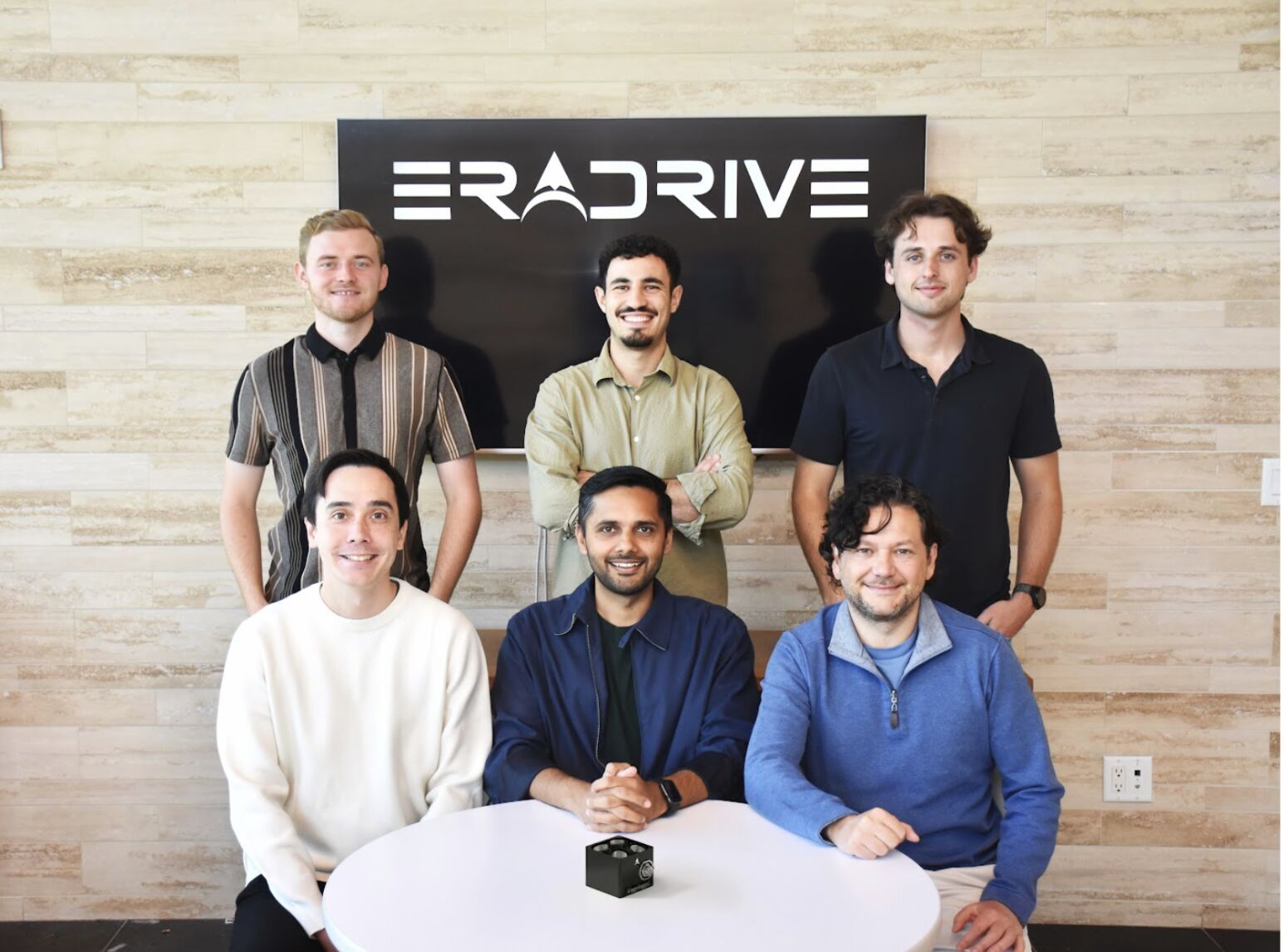
The EraDrive team.
Space Dirt: What’s your approach to building your team and company culture in the hard tech space?
Sharma: We are building an intentional mix of people with deep experience from large, conventional aerospace missions, people who have built and operated in new space, researchers from academia who bring cutting-edge methods, and engineers from adjacent autonomy industries like autonomous driving, aviation, and robotics. Each group contributes a distinct strength, whether it is mission assurance discipline, speed to flight, frontier algorithms, or productizing perception and decision systems at scale. Our culture is designed to take the best from each domain: high ownership, direct communication, and rigorous engineering practices that let us move quickly while still building systems that can be trusted in orbit.
Space Dirt: What’s the best piece of advice you’ve received as a founder, and what advice would you give to someone just starting their hard tech journey?
Sharma: The best advice I received, and the one I would pass on to founders starting in hard tech, is to expect most investors to pass with some version of “very interesting, but I don’t do what you do,” and not to internalize it. What changes the trajectory is paid, referenceable customers. A practical heuristic is that if you can earn 10 paid, referenceable customers, investors can believe you can earn 1,000. This is also a good strategy for staying focused. Hard tech is a long game, and it is easy to get distracted by whatever trend, bubble, or social-media zeitgeist is getting attention in the moment. Customer pull is a much better compass than external noise. When you anchor your roadmap to real deployments and real outcomes, you are far less likely to chase fashionable ideas that do not compound into durable product value.
Thanks for reading our first edition of The Founder Five.
If you know someone else who might enjoy this interview, click the button below to share it.
And if you’d like to be featured in a future issue, reach out.
-Erik
Erik Stiebel
Founder and Vice President
CA DRE License #02080746
424.241.4795 | [email protected]
Follow me on 𝕏
Reply