- Space Dirt
- Posts
- April's Space Dirt 🚀 (month-end)


Real quick, before we get going. I’m co-hosting an event in May in Gundo - if you’re around, come by (info below).
Lots going on over the last 2 weeks:
12 Real estate highlights
6 Companies emerging from stealth
Real estate corner: Helping a client move (literally) + Gundo vs. Long Beach
20 Notable fundings
10 Agreements, partnerships & contracts
What I’m consuming
Enjoy!
REAL ESTATE HIGHLIGHTS
Titan Dynamics leased 34,734 SF at 20000 S Vermont Ave, Torrance, CA. (source: Me!)
Anduril signed a lease for 177,766 SF at 1100 Valencia Ave, Tustin, CA. The building will serve as a centralized warehouse supporting Anduril’s headquarters and nearby facilities as it scales up logistics to support its growing defense technology capabilities. (source: Orange County Business Journal)
Foundry Robotics is launching its robot factory in San Francisco, CA. (source: X)
The robots are coming. (image: REK)
REK signed a lease for the first humanoid store in the US. Coming to San Francisco’s Nob Hill in about 2 months. The store will have robot repairs, rentals, customizations, tune-ups, and demonstrations. “Think of it as a car shop for humanoids.” The first models will be from @UnitreeRobotics, @AGIBOTofficial, @engineairobot, and @boosterobotics. (source: X)
Fuse Energy Technologies is building a new radiation testing facility in Albuquerque, NM, expanding US capacity to test defense, space, and semiconductor systems in extreme environments. The facility is expected to begin operations by summer 2026. (source: The Defense Post)

Atomic Semi’s new Austin, TX HQ. (image: Costar)
Atomic Semi left California and moved to a new 122,400 SF headquarters for R&D and production, located at 6301 Stassney Lane, Austin, TX. (source: X)
The Colorado Quantum Incubator (COQI) announced the development of the nation's first open-access, commercially available third-party validation testbed for quantum timing technologies, located at BioMed Realty’s Flatiron Park (2108 55th Street, Boulder, CO). This facility will be home to the quantum incubator, where companies, research institutions, and government agencies can, for the first time, test and demonstrate precision timing technologies for the commercial, defense, and research markets. (source: BusinessWire)
Antares opened a new office at 215 Richland Ave E, Aiken, SC. (source: Yahoo! News)
The Nuclear Company, a startup focusing on rapid, fleet-scale nuclear construction, is setting up its primary engineering office in Columbia, SC, to deploy a 6-gigawatt nuclear reactor fleet, with potential to utilize sites like the abandoned V.C. Summer nuclear project. Using "design once, build many" methodologies to meet AI-driven energy demand, the firm is collaborating with local partners to tackle regulatory, engineering, and workforce needs. While efforts are underway, the projects face extensive feasibility and federal regulatory licensing processes, with some financial milestones expected in 2026-2027. (source: Bloomberg)
YOU’RE INVITED

Join us!
I’m co-hosting a happy hour with my friends at Boundary at Old Town Patio on Thursday, May 14, from 6 to 9pm. You can find more details and RSVP here.
STEALTH NO MORE

Crewline makes the vibratory compactor autonomous. (image: Crewline)
Crewline raised $7.1M in seed funding to automate the job nobody wants: driving the vibratory roller. The round was led by Initialized Capital and Nebular, with participation from Ford Street Ventures, Cocoa Ventures, Begin Capital, and a network of construction-tech angels. The company launched out of Entrepreneurs First. Frederik Filz-Reiterdank is a Co-founder and CEO.
The product is a retrofit autonomy kit that bolts onto existing vibratory compactors — Caterpillar, BOMAG, HAMM, Volvo, CASE — in about an hour, without cutting wires or voiding warranties. A foreman maps the work zone on an iPad; the machine compacts autonomously within that boundary. Operators can take manual control at any time. No upfront fees: Crewline charges a fixed monthly rate per machine that bundles remote monitoring, on-site field service, and 24/7 operations support. Between December 2025 and April 2026, the company went from announcing its seed to deploying on live earthworks projects in Texas and Pennsylvania, adding Bechtel and Haydon Companies to its prospect list, and fielding inquiries from 241 contractors representing roughly $26M in potential annual contracts after appearing at CONEXPO.
Dozers are already in development, slated for 2027. Rock trucks and excavators are further out on the roadmap. (source: LinkedIn, Founderland, and Fast Company)

Bubble Robotics raised $5M in pre-seed funding to build what it calls the ocean's autonomous workforce: resident robotic systems capable of operating continuously at sea for weeks to months without human intervention. The round was co-led by Episode 1 Ventures and Asterion Ventures, with participation from Norrsken Evolve and Angel Invest. The company launched out of Entrepreneurs First and was founded in 2025 by robotics engineers from NASA and ETH Zürich. Jean Crosetti is the Co-founder and CEO.
Subsea infrastructure — offshore energy, undersea cables, carbon storage, maritime security — is expanding rapidly, and the operational model for maintaining and monitoring it hasn't changed in decades. It still requires expensive vessels, limited dive windows, and human crews that can't scale. The core platform combines autonomous docking, long-duration persistence, and low-cost underwater navigation to generate continuous, high-resolution digital twins of subsea assets and environments. The model is explicitly analogous to satellite constellations — instead of episodic survey missions that require surface vessels and crews, Bubble deploys resident systems that stay on-station and keep watching. (source: Bubble Robotics and LinkedIn)
Humble Robotics raised a $24M seed round led by Eclipse, with Energy Impact Partners and RedBlue Capital, to build what Founder and CEO Eyal Cohen describes as a clean-sheet redesign of the freight truck. The flagship product is the Humble Hauler: an autonomous, electric, cabless vehicle engineered from first principles around one question — what's the lowest possible cost per mile to move freight?
The answers cascade from that question. Remove the cab: it's weight and space that exists entirely for a human driver. Integrate the trailer: eliminating the coupling process, one of the most time-consuming and error-prone tasks in trucking. Electric powertrain: reliability, lower operating cost, insulation from fuel price volatility. The team built its first prototype in six months and is already moving toward testing and commercial partnerships. (source: Humble Robotics and LinkedIn)
Sygaldry Technologies announced $139M in total funding — a $34M seed led by Initialized Capital, followed by a $105M Series A led by Breakthrough Energy Ventures, which closed in March. The company was co-founded by Chad Rigetti, who previously founded Rigetti Computing in 2013, alongside Idalia Friedson and AI scientist Michael Keiser.
The thesis: the central constraint on AI infrastructure isn't raw compute — it's the cost and energy it consumes. Sygaldry is building quantum-accelerated servers designed to run alongside classical chips inside existing data centers, targeting the specific AI algorithms — training and inference — that are hardest to run efficiently on conventional hardware. The approach isn't quantum as a replacement for silicon. It's quantum as targeted acceleration, plugged into tools AI researchers already use.
Additional investors include Y Combinator, Morpheus Ventures, IQT, 468 Capital, and the University of Michigan. (source: LinkedIn and Fortune)
Haladir (YC W26) raised a $4.3M seed round to build what it describes as operational superintelligence for logistics. The round was led by BoxGroup and Susa Ventures, with participation from Sunflower Capital, Valkyrie Ventures, XPRESS Ventures, and angels, following prior backing from Y Combinator (W26) and SV Angel.
The platform sits between the existing software stack — WMS, TMS, OMS — and the humans currently making decisions on top of it. Haladir unifies data across those systems, deploys event-driven agents with actual execution authority, and embeds solver-grade optimization into 3PL and distributor operations. The pitch on operational superintelligence has three components: speed (decisions that take ops managers and OR analysts weeks, made in seconds), reliability (every decision guaranteed to satisfy operational constraints), and scope (optimization across thousands of simultaneous constraints no human team could reason about). The company is also building reinforcement learning environments for frontier AI labs as a secondary product line. Jibran Hutchins is a Co-founder and the CEO. Joseph Tso, Quan Huynh, and Preston Schmittou round out the co-founding team. (source: LinkedIn, Y Combinator, and Haladir)
Skyfire | AI raised $11M in seed funding to build what it calls an AI-native platform for coordinated multi-drone operations. The round was led by Mucker Capital, with participation from AI Fund, SaaS Ventures, Halogen Ventures, Harvard Business School Alumni Angels, and New York Angels.
The core product reframes how operators interact with drone fleets. Instead of piloting individual aircraft, operators manage outcomes across multiple simultaneous missions — setting objectives and letting the platform handle coordination, routing, and real-time adjustments across the full mission lifecycle from planning through execution. Current use cases include emergency response, search and rescue, and critical-incident monitoring. The company is headquartered in Huntsville, AL, placing it in the middle of one of the country's densest defense and aerospace corridors. CEO Don Mathis co-founded the company alongside Eric Malawer, Brian Davidson, and Matt Sloane. (source: LinkedIn)
REAL ESTATE CORNER

SOUTH BAY SUBMARKET COMPARISON
El Segundo Versus
A lot of my clients ask me to compare South Bay submarkets. I figured other people are asking the same questions, so I'm sharing what I'm seeing from representing clients in the South Bay.
I'm calling the series "El Segundo Versus".
First up: El Segundo vs Long Beach
I'd be lying if I said I wasn't partial to Gundo (we HQ here), but my job is to help clients find the right space at the right time in their growth cycle. So I stay agnostic.
Based on deals in both markets, my breakdown is below.
If you have a question or would like more intel, feel free to DM me.
One thing I didn’t include here: local government support.
It can obviously play a big part in certain real estate situations, especially in hard tech. But given that I have to work with all of the local governments, I didn’t want to get into a situation where I was publicly grading them. Privately, always happy to share my experiences. That said, El Segundo and Long Beach city officials seem to be very pro-business and helpful.
Also, they must currently have a presence in the market to be included in “Who’s here.” For example, Anduril WILL have a presence in Long Beach, but not yet.

PARTNER WITH SPACE DIRT🚀
Get your product or service in front of a community of 3,300 hard tech executives, entrepreneurs, and investors.
If you’re interested in partnering with Space Dirt, email us here to see if we’re a good fit.
NOTABLE FUNDINGS
AEVEX Corp rode a surge in defense spending and investor appetite for military tech to raise $320M in its U.S.IPO, pricing shares at $20 apiece, near the top of its indicated range. The California-based drone maker sold 16 million shares between $18 and $21 each. Goldman Sachs, BofA Securities, and Jefferies acted as joint bookrunners. AEVEX trades on the New York Stock Exchange under the ticker “AVEX”. (source: Benzinga)
NASA is investing in the next wave of space technology. More than 30 companies are receiving over $16M in funding through programs designed to support early-stage innovation. The goal is not just to support space missions, but also to help these technologies find use beyond space. This approach highlights how smaller companies and research partnerships are playing a growing role in shaping the future of the space economy. (source: X)

True Anomaly announced its $650M Series D financing, bringing its total capital raised since its 2022 founding to over $1B. The round was co-led by Eclipse and Riot Ventures, with support from new investors Paradigm, Atreides, G Squared, The Private Shares Fund, VanEck, and others, alongside existing investors Accel, Menlo Ventures, ACME Capital, Space VC, Meritech Capital, Narya, and 645 Ventures. It includes $50M in debt provided by Stifel Bank. (source: True Anomaly)
Nuclear startup X-energy raised $1B in its IPO, selling 44.3 million shares for $23 each, a hefty premium above the $16 to $19 per share it was seeking. Initially, the company had hoped to raise around $800 million. The stock is expected to begin trading on Friday on the Nasdaq Exchange under the ticker XE. X-energy is building small modular reactors capable of generating electricity or delivering heat to industrial processes. The company has a deal with Dow to provide heat and power to a chemical plant in Texas and another with Amazon to sell as much as 5 gigawatts of nuclear power by 2039. Amazon’s Climate Pledge Fund led X-energy’s Series C-1 round. (source: TechCrunch)
Blue Energy, a developer of financeable, prefabricated nuclear power plants, announced that it has raised $380M in financing to advance its turnkey approach to nuclear plant development. The fundraise was led by VXI Capital with significant backing from Engine Ventures and participation from other existing investors, including At One Ventures and Tamarack Global. Proceeds will support procurement of long-lead equipment, project development activities, and general corporate purposes. (source: Blue Energy)

Glydways has raised $170M in a Series C. (image: Glydways)
Glydways, a San Francisco, CA-based startup developing personal autonomous pods designed to operate on dedicated 2-meter-wide lanes in cities, has raised $170M in a Series C funding round. The round was co-led by Suzuki Motor Corporation, ACS Group, and Khosla Ventures. Existing investors Mitsui Chemicals and Gates Frontier, and new investor Obayashi Corporation, also participated. Now it seems the startup is already in discussions to raise another $250 million in funding that would push its valuation to more than $1 billion, Bloomberg reported. (source: TechCrunch)
Reliable Robotics, the leader in autonomous aircraft systems, announced $160M in new funding to accelerate deployment and scale production of the Reliable Autonomy System (RAS) – the first Federal Aviation Administration (FAA) certifiable system enabling fully automated operation of an aircraft. The financing follows commitments for over 200 systems from commercial and military customers, and selection for the United States Department of Transportation’s “eIPP” advanced aviation pilot program. The financing was led by Nimble Partners, with continued support from Eclipse, Lightspeed, Coatue and Pathbreaker Ventures. New investors include Island Green Capital, Socium Ventures (Cox Enterprises), AE Ventures (a strategic partner of the Boeing Company), RTX Ventures, Presidio Ventures (Sumitomo Corporation), UP.Partners, KAS Venture Partners, What If Ventures, Calm Ventures, Gaingels, and Mana Ventures. (source: BusinessWire)
Skydio has raised $110M in Series F financing, led by existing investors. This round raises its valuation to $4.4B. And, not exactly funding, but an investment in America…Skydio also announced plans to invest $3.5B in the United States over the next five years to expand its domestic manufacturing, accelerate R&D, and strengthen American supply chains. The investment is expected to create over 2,000 new Skydio jobs, support the creation of more than 3,000 additional roles within the U.S. supply chain, and direct more than $1B to domestic suppliers. (source: X and Skydio)
Scout AI has raised $100M in a Series A round led by Align Ventures and Draper Associates, following its $15 million seed round in January 2025. The company is building an AI model it calls “Fury” to operate and command military assets, first for logistical support, but soon for autonomous weapons. CTO Collin Otis compares this work, which builds on existing LLMs, to training soldiers. (source: TechCrunch)
Firestorm Labs announced that it has secured $82M in Series B funding. The round, led by Washington Harbour Partners with participation from NEA, Ondas, In-Q-Tel, Lockheed Martin Ventures, Booz Allen Ventures, Geodesic, Motley Fool Ventures, and others, brings Firestorm's total funding to date to $153M. Following successful demonstrations for the U.S. Air Force and Army, Firestorm is now transitioning to scaled production and expanded fielding across operational theaters for the Department of War (DoW). The company's expanded fielding efforts are focused on operational units in the Indo-Pacific, where contested logistics challenges are most acute. (source: Access Newswire)
Elevate Renewables, a Boston, MA-based developer and operator of energy infrastructure, secured a $50M Energy Transition Supplier Finance Facility arranged by Rabobank to support a large solar and battery energy storage project contracted to power a data center, underscoring the growing link between energy systems and the digital economy. (source: LinkedIn)
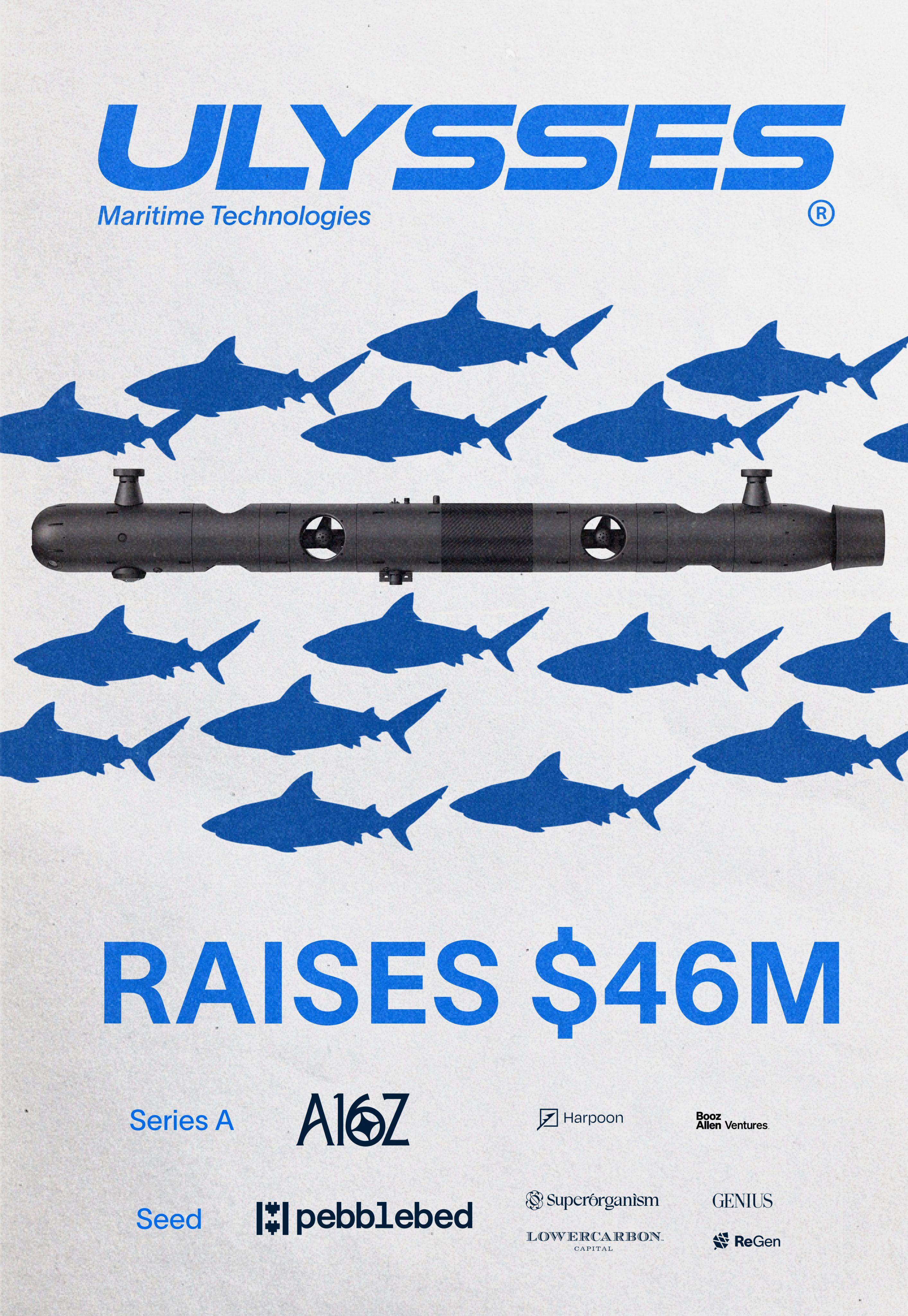
Ulysses, an SF-based unmanned underwater vehicle company, has raised $46M. The $38M Series A was led by Andreessen Horowitz, joined by Booz Allen Ventures and Harpoon Ventures. The $8M seed was led by Pebblebed, joined by Genius Ventures, Lowercarbon Capital, Superorganism, and ReGen Ventures. (source: X)
Lockheed Martin announced a $25M investment in Utah-based counter-drone startup Fortem Technologies, a sum that, according to the prime, represents “the initial tranche of Fortem’s Series B fundraising round” and will accelerate production and deployment of Fortem’s tech within Lockheed’s Sanctum c-UAS ecosystem. (source: Tectonic)
Humble Robotics, a San Francisco–based provider of autonomous electric haulers, has raised $24M in seed funding in a round led by Eclipse with participation from Energy Impact Partners and other investors. The company is building fully autonomous Class 8 electric trucks designed for complex commercial freight logistics, using vision-language-action (VLA) models paired with lightweight hardware on a universal platform that supports multiple vehicle configurations. The new funding will support vehicle development, expansion of autonomous driving infrastructure, launch of initial pilot programs, and early-stage production. (source: LinkedIn)
Hyfix Spatial Intelligence raised a $15M seed round to create an American-made “brain” for drones and robots. The Santa Clara, CA-based startup is developing a single autonomous-systems chip that folds flight control, high-precision positioning, secure communications, and onboard compute into one U.S.-manufactured system-on-a-chip. This replaces the mix-and-match electronics that power most drones today. Craft Ventures led the round, joined by Catapult Ventures, Multicoin Capital, Finality Capital, and hard-tech investor Sky Dayton. (source: Yahoo! Finance)
INTALUS raised an $11M seed round with participation from Origin Ventures, Scout Ventures, Lockheed Martin Ventures, and additional investors. (source: LinkedIn)
Crewline raised $7.1M in seed funding led by Initialized Capital and Nebular. That figure appears to be an extension of a $5.5M seed round that Crewline disclosed back in December 2025, with the same lead investors. (The company declined to clarify the funding structure beyond confirming the new total.) (source: Founderland)
Rhea Space Activity (RSA), a leader in deep space GPS-denied navigation with the optical software “AutoNav,” announced the close of its ~$6M Series A round to accelerate its growth and respond to demand for its GPS-independent navigation software from the U.S. and allied partner military/intelligence customers. Funding from Boston Global (BG) Space Tech Investors, Iron Prairie Ventures, Blackbird Capital Group, Purdue Research Foundation, New Mexico Vintage Fund, SpaceFund, and others provides a strong foundation for RSA to expand AutoNav’s deployment across AUKUS, Five Eyes nations, NATO, and other U.S. allies. These funds also enable Rhea Space Activity to scale resilient PNT capabilities for hyperscale defense manufacturing and operations in GPS-denied environments, accelerating hiring, production, system validation, and supply chain resilience to meet urgent U.S. and allied mission needs across contested domains. (source: Rhea Space)
iCardio.ai has closed a $4.5M strategic financing led by Cedars-Sinai Technology Ventures. This capital will support its mission to bring echocardiography, the most ubiquitous imaging modality in cardiology, to its next era: artificial intelligence. “We are grateful for the continued support of our existing investors and are pleased to welcome a strategic consortium of additional investors to the round, including Cove Fund, the Alliance for SoCal Innovation, Boomerang Ventures, 100KM Ventures, and others.” (source: LinkedIn)
Retina Robotics has closed $2.67M in total funding, helping bring warehouses one step closer to a truly hands-free, scan-less future with our WAMs™. Investors included: Heartland Ventures, Array Ventures, Brickyard, Forum Ventures, High Water Venture Partners, Service Provider Capital, Illinois Science and Technology Coalition, and Stuart Gardner. “I'd also like to thank Kevin Lawton, CLTD, Abhishek Jagadeesh Kasaragod, Vivek Patel, as well as our friends, family, and partners, who have had our backs since day one.” (source: LinkedIn)
New Fund
New York-based VC Nomi Capital announced that it has raised a $50M Fund I, which it will deploy into later-stage defense tech startups this year, with over $20M already allocated to six companies out of about 10 positions targeted in total. Founded in 2024, Nomi may be the new kid on an increasingly crowded block, but founder and managing partner Jason Zins—a former partner at SkyBridge Capital—and his first hire, Brent Gerundo, a US Army Special Operations veteran and former defense investment banker at Goldman Sachs, are looking to do things a little differently. (source: Tectonic)
AGREEMENTS, PARTNERSHIPS, & CONTRACTS
The US Navy has awarded Castelion a $105M contract to integrate Blackbeard, the Navy's first air-launched hypersonic strike weapon, onto the F/A-18E/F Super Hornet and transition the system to an Early Operational Capability in 2027. Under this award, Castelion will conduct extensive system safety and certification testing, flight testing, and other integration activities related to carrier-based operations. (source: Castelion)
Striveworks, an AI-for-defense startup, has secured a $70M multi-year enterprise agreement (EA) with the U.S. Department of Defense (DoD) to scale its AI deployment capabilities across the military. The contract allows all Department of Defense components—including the Army, Navy, and combatant commands—to access the company's "Chariot" software platform. (source: Tectonic)
Nominal announced it has been awarded a sole-source, multi-year Indefinite Delivery, Indefinite Quantity (IDIQ) contract by the Air Force Test Center (AFTC). The contract, which carries a ceiling of $53M, represents a Small Business Innovation Research (SBIR) Phase III transition, following Nominal’s successful Phase II performance with the U.S. Air Force Test Pilot School (TPS). (source: Nominal)
Beacon AI, an aviation software technology company building advanced systems to augment commercial and defense pilots, announced it has signed a 4-year Prototype Other Transaction Authority (OTA) agreement with the U.S. Special Operations Command (USSOCOM) with a total size of up to $49.5M. The agreement includes participation from Air Force Special Operations Command (AFSOC) and other Department of Defense organizations and contains a production clause intended to accelerate the transition to operational fielding. (source: Beacon AI)

Redwire’s Stalker Block 30 (image: Tectonic)
Space and defense giant Redwire announced that it’s been awarded $20M in follow-on orders from the Navy and Marine Corps Small Tactical Unmanned Aircraft Systems Program Office (PMA-263) for a new, advanced navigation version of its Stalker drones. Redwire has already delivered over 250 Stalkers to PMA-263 for the Marine Corps—think of this as an upgrade that will boost capability for “long-range reconnaissance missions where drones must operate in contested, GPS-denied environments over vast distances.” (source: Tectonic)
PlanetiQ announced it has been awarded a $15M, 48-month Strategic Funding Increase (STRATFI) contract by the U.S. Air Force. The program will support the development and launch of spacecraft equipped with next-generation Global Navigation Satellite System (GNSS) RO, R, and PRO instruments and the delivery of high-value weather data to the US Air Force. The mission will focus on advancing GNSS-RO (radio occultation), GNSS-PRO (polarimetric radio occultation), and GNSS-R (reflectometry) capabilities. In addition, the program includes developing advanced data assimilation techniques to integrate enhanced GNSS-PRO data into Numerical Weather Prediction (NWP) models, thereby improving forecast accuracy and enabling new insights into atmospheric conditions. (source: PlantetiQ)
Overland AI has been awarded a $2M ADAS (Advanced Driver Assistance System) contract with the U.S. Army. This effort will enhance the safety and survivability of the Army's ground combat vehicle suite by leveraging the same perception and planning systems that underpin our state-of-the-art autonomy. As fully autonomous and optionally manned platforms expand throughout the Army's arsenal, Soldiers will have that same technology working for them on every mission. (source: X)
Rivian and critical materials and energy technology company Redwood Materials announced a partnership to deploy battery energy storage at Rivian’s Normal, Illinois, manufacturing facility. Using more than 100 second-life Rivian battery packs, Redwood and Rivian’s solution will initially provide 10 megawatt-hours (MWh) of dispatchable energy to reduce cost and grid load during peak demand periods—saving on cost and supporting grid security and reliability. Rivian will provide EV battery packs to Redwood, which will integrate them into a Redwood Energy system supported by the company’s Redwood Pack Manager technology, enabling the stored energy to be used on-site at Rivian’s plant in Normal. (source: Redwood Materials)
Picogrid wins Army c-UAS Integration contract. Under the new contract, Picogrid will “support rapid onboarding of new technologies, data sharing across different networks, coordination across multiple systems, and continued experimentation with forward-deployed units,” according to the company. The contract was facilitated by the Army’s Joint Innovation Outpost (JIOP), which focuses on delivering rapid innovation and new tech to the XVIII Airborne. Terms of the deal were not disclosed. (source: Tectonic)
The Golden Dome Program
The development of on-orbit missile interceptors is one of the bigger technical lifts of the Golden Dome program, an initiative announced by President Donald Trump last year that aims to stitch together a sprawling, layered “shield” to protect the U.S. from both traditional and advanced missile threats. According to Space Systems Command’s announcement, the service expects to integrate the space-based interceptors into the Golden Dome architecture by 2028 and ultimately launch a proliferated SBI constellation in low Earth orbit.
The service issued two solicitations last year calling for industry prototypes of systems capable of destroying a missile during the boost and midcourse phases of flight. Golden Dome Director Gen. Michael Guetlein announced in December that it had awarded 18 other transaction-agreement contracts, but did not disclose the value of those deals or the firms that received them. According to SSC, the following companies are on tap for the effort:
Anduril Industries
Booz Allen Hamilton
General Dynamics Mission Systems
GITAI USA
Lockheed Martin
Northrop Grumman
Quindar
Raytheon
Sci-Tec
SpaceX
True Anomaly
Turion Space
The program’s goal of demonstrating SBIs by 2028 means SSC will need to move quickly, Program Executive Officer for Space Power Col. Bryon McClain said in a statement. (source: Air & Space Forces Magazine)
WHAT I’M CONSUMING (AND ENJOYING!)
🔮 Bessemer Venture Partners put together a list of six investor predictions on robotics and physical AI. Read it at the link or watch the YouTube video above.
📍The Wall Street Journal takes a look at Proto-Town, a 1,200-acre campus in Lockhart, Texas, a suburb of Austin. It serves as a business commune for young tech founders and other entrepreneurs who all live and work there.
👷♂️ Emma Steuer visited TerraFirma’s Robot Ranch to learn more about how they are changing the construction industry.
📈What if machine shops could be franchised to help with consistency in the final product? This GearSolutions article takes a look at Isembard’s business model.
📖 Grant Gregory and his team at Cantos released the next iteration of The State of Adventure, an ongoing series on all the progress and innovation in the physical world.
📘 Kyle Harrison of Contrary Research dropped The Anduril Thesis, a 300-page book covering 100 years of military history that explains everything about Anduril.
😂 I’ve been enjoying the takes and opinions from Gurth Defense.
📅 One more event: LA Hard Tech Trivia on May 21st. Hard Tech Trivia is a new monthly gathering of LA's hard tech community: engineers, technical founders, and operators building the things you read about in Space Dirt. More details and RSVP here.
HOW I CAN HELP YOU
Here are 3* ways I can help when the time is right:
Find a new home for your growing business. You're scaling fast, and you don't have time to become a CRE expert. I do this every day.
Sublease your space. Outgrown your office, but don't want to pay two rents? I'll help you find a subtenant.
Negotiate your lease renewal. Want to make sure you’re getting a fair deal from your Landlord? In my experience, you can never be too sure. Start 12 months out, so you're not scrambling at the last minute.
Strong references available. Let's talk.
*Not an exhaustive list 💪
Thanks for reading.
If you’d like your office and/or manufacturing space or business profiled - or even your city! - let me know. It’s always fun to explore and share the different components of the hard tech industry.
Erik Stiebel
Founder and Vice President
CA DRE License #02080746
424.241.4795 | [email protected]
Follow me on 𝕏
Reply