- Space Dirt
- Posts
- March's Space Dirt 🚀 (mid-month)

March Madness. Almost 5,000 words on all things hard tech. Here’s what’s in store:
15 Real estate highlights
7 Companies emerging from stealth
Real estate corner - the life of an entrepreneur
14 Notable fundings
11 Agreements, partnerships & contracts
What I’m consuming
Enjoy!
REAL ESTATE HIGHLIGHTS
Faraday Future leased 99,600 SF at 1990 E Grand Ave, El Segundo, CA. (source: Me!)
Standard Subsea (fka Amidon Heavy Industries) leased 5,966 SF at 201 Nevada St, El Segundo, CA. (source: Me!)
Varda leased 205,443 SF at 2031 E Mariposa Ave, El Segundo, CA. This is the former Mattel plant. (source: LA Times)
FlightWave Aerospace Systems leased 51,023 SF at 2660 Columbia St, Torrance, CA. (source: Me!)
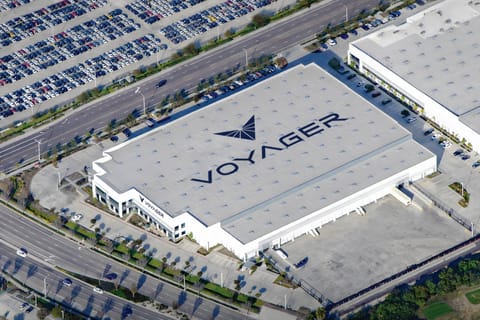
Voyager Technologies announced a new 140,000 SF facility at 4350 E Conant St, Long Beach, CA. This opening follows Voyager's expansion in Pueblo, CO, in January 2026, marking a significant increase in its U.S. manufacturing footprint for defense and space sectors. (source: Voyager)
Hadrian announced the development of its new manufacturing facility, Factory 4, at the Barton Riverfront Industrial Park in Cherokee, AL, located in the Shoals region of Northwest Alabama. The facility is slated to be 2.25 million SF. A grand opening ribbon-cutting ceremony is scheduled for March 20, 2026. The project represents a $2B investment and the facility is expected to create over 1,000 new jobs. The announcement marks a significant expansion for the company, aimed at strengthening domestic manufacturing and U.S. Navy defense supply chains. (source: LinkedIn)
Shinkei has acquired a 16,000 SF processing facility in Tacoma, WA, its first fully owned Seremoni Grade plant. The facility more than doubles Shinkei’s operational footprint and places it directly alongside some of the most important fisheries on the West Coast. By owning and operating the facility end-to-end, it can maintain complete quality control from the moment a fish leaves the water through its proprietary harvesting methods and in-house processing. The Tacoma plant will also serve as the launch site for NERA, Shinkei’s next-generation quality system that analyzes each fish in real time to evaluate freshness, shelf life, and optimal distribution. (source: SeaFood Source)
Boom is building a 200,000 SF factory in Denver, CO, where it will build 1-2GW/year of turbines from raw materials. (source: X)
Impulse opened a 20,000 SF manufacturing facility near Boulder, CO, to develop hardware and subsystems for its Mira and Helios transfer vehicles. (source: Axios)
LEAP Space is unveiling its new HQ next month at 295 Interlocken Blvd, Broomfield, CO. (source: LinkedIn)
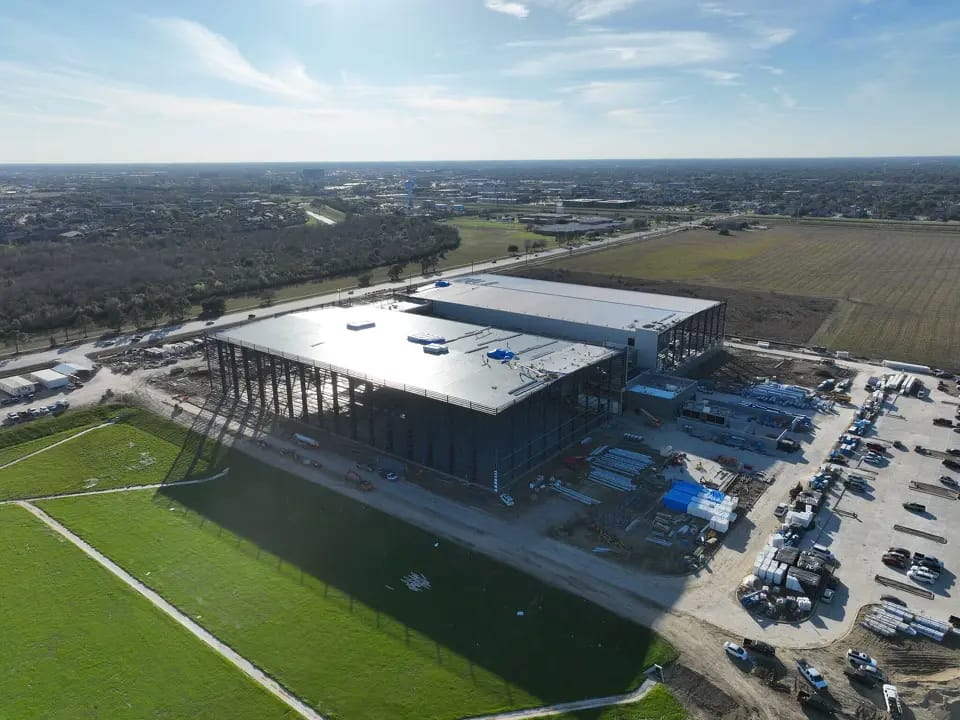
Texas A&M’s $200 million Space Institute is set to open this fall. (image: Texas A&M)
Texas A&M’s $200 million Space Institute is set to open this fall, a move officials say will put Texas at the center of space exploration for at least the next 50 years. The four-story facility, which broke ground in 2024, is located on a 32-acre lot next to NASA's Johnson Space Center. Once complete, it will contain the world's largest moon and Marscapes. On the back side of the building will be a technical RV park, a plot with numerous power hookups and network connections that can adapt to evolving technologies. In addition, an open-design utility corridor running through the center of the building can be equipped with additional power, fluids, gases, and other resources as needed. (source: Chron)
Allen Control Systems (ACS) announced that it is tripling the size of its Austin facility to 57,000 SF to scale low-rate initial production and research, development, testing, and evaluation capabilities for Bullfrog, its autonomous counter-drone system. ACS builds robotic turrets to shoot down drones. This is expected to help increase production and testing and accelerate deliveries. The company also plans to triple its workforce, hiring for engineering and technical roles to accelerate systems development, testing, and delivery. (source: Defense One)
iCOMAT is launching a 41,000 SF R&D and manufacturing facility in Dayton, OH. This is the UK-based iCOMAT’s first North American facility. (source: LinkedIn)
Karman Space & Defense announced it will open a new, state-of-the-art facility in the greater Salt Lake City, UT area to expand its advanced UAS launcher systems and SRM nozzle production capacity to meet substantial increases in customer demand. (source: Business Wire)
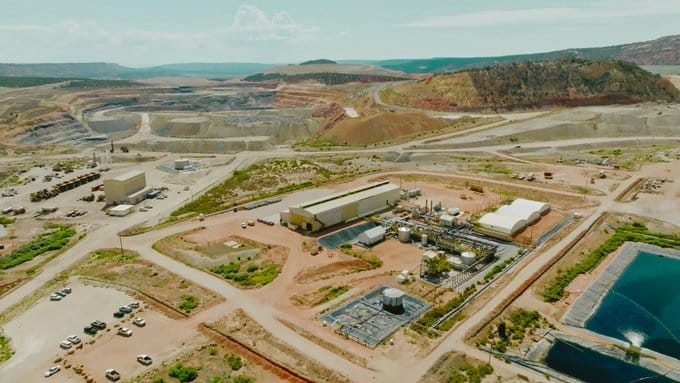
Mariana Minerals’ new copper mine in Utah. (image: Mariana Minerals)
Mariana Minerals acquired the Centennial copper mine and refinery in southeastern Utah from Lisbon Valley Mining Co. LLC last year and will reopen it in April. The site includes an existing open-pit mine, a heap bioleaching operation, a hydrometallurgical refining circuit utilizing solvent extraction and electrowinning, and significant expansion potential. Over the past 12 months, Mariana partnered with the existing site team to develop and deploy advanced software and autonomous systems that will overcome past operational challenges and expand copper output. (source: Mariana Minerals)
STEALTH NO MORE
Piris Labs is building a full-stack inference service that eliminates the AI data movement bottleneck by pairing proprietary photonic hardware with a vertically optimized software stack to minimize the memory wall associated with expensive GPUs. Copper-based interconnects cannot keep pace with modern models, limiting data movement between and within compute and memory, leading to high latency, inefficient hardware utilization, and unsustainable inference costs. The company's system combines proprietary optical interconnects with purpose-built software designed to maximize hardware utilization, delivering 5x lower latency, 10x lower power per bit, and 2x lower cost per token, making the unit economics of trillion-parameter models sustainable. Founded by Ali Khalatpour and Keyvan Moghadam. The company has built a working π Conversion Engine prototype and secured an SBIR government partnership. (source: Y Combinator)
Origami Robotics builds high-DOF robotic hands with in-joint motors and co-designed data-collection gloves that match each other exactly, eliminating the embodiment gap to enable direct deployment of real-world data to hardware. The company has already sold hands to Physical AI labs, including Amazon. The problem: large transmission often found in current robotic hands makes dynamics extremely hard to model, and the embodiment gap between robotic and human hands (different kinematics, contacts, and sensing) creates distribution gaps too large for policies to pick up skills for real, useful tasks. By optimizing miniature motor design and co-designing data-collection gloves alongside the robotic hand, Origami minimized sim-real and embodiment gaps that have haunted the robotics research community. The technology enables the easy transfer of learned skills from simulation to real-world scenarios and leverages thousands of hours of minimally embodied real-world data to train the exact manipulation policies needed. Founded by brothers Quanting and Ryan Xie. (source: Y Combinator)
Albuquerque-based Mantis Space raised over $10M in an oversubscribed seed round led by Rule 1 Ventures alongside Montauk Capital (which incubated the company through its venture studio platform) to build orbital energy infrastructure that eliminates Earth's shadow constraint. Every satellite today operates under the same fundamental limitation: power generation depends entirely on direct sunlight, with satellites spending nearly one-third of their life in Earth's shadow, where energy production stops and systems rely on battery reserves. Many satellites are placed in orbits designed primarily to maximize sunlight exposure rather than optimize mission productivity. Sun Synchronous orbits leave satellites outside their revenue-generating areas up to 70% of every day. Mantis is building a constellation of spacecraft that remain almost continuously in sunlight and transmit power to satellites operating in eclipse, allowing satellites to receive power through their solar arrays in real time, regardless of position relative to the sun. This infrastructure enables satellites to remain in their most productive orbital positions rather than chasing sunlight, significantly increasing mission utilization and improving the economic return of satellite systems by 2-3x. Founded by Eric Truitt, Hugh Wyman Howard III, and Jeremy Scheerer. All three founders are U.S. military veterans. (source: PR Newswire)
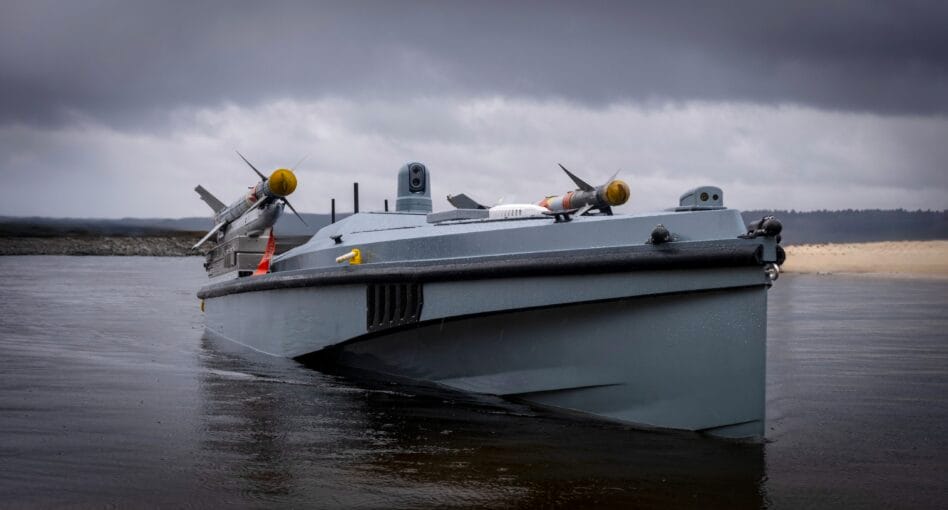
UFORCE emerged from stealth with $50M in seed funding. (image: Tectonic)
London-based UFORCE emerged from stealth with $50M in seed funding at a valuation exceeding $1 billion, led by Shield Capital and Lakestar with participation from Ballistic Ventures, becoming the first Ukrainian-founded defense tech unicorn. The company is a strategic consolidation of nine specialized Ukrainian defense companies that have iterated and refined technologies under combat conditions over the past four years, delivering a comprehensive suite of autonomous solutions, including aerial interception, maritime dominance, and battlefield management software. The flagship MAGURA uncrewed surface vessels have struck over 12 Russian warships and became the first in history to shoot down manned helicopters and fighter jets. Other products include Nemesis strike drones, combat robotics, and counter-UAS systems capable of blocking Iranian Shahed drones used by Russian forces. The company has manufacturing and sources materials from 15 locations across six European allied countries, is already profitable, with bookings in the hundreds of millions of dollars that grew 450% in 2025, and has a team of over 1,000 engineers, developers, and operators. Founded by Oleg Rogynskyy and Oleksiy Honcharuk. (source: Tectonic)
Northern California-based iMetalX emerged from stealth to announce a collaboration with Psionic on autonomous space operations, pairing Psionic's Space Navigation Doppler Lidar with iMetalX's Asgard data and simulation platform to create accurate 3D models of resident space objects within minutes. The company has brought in $6.2M in funding from military contracts, including AFWERX and SpaceWERX SBIR awards. iMetalX pivoted from 3D printing and metallurgy (won a 2013 ARPA-E contract for titanium production) and autonomous aircraft/underwater vehicles toward the space sector after participating in the 2019 Hyperspace Challenge. The company's full-stack autonomous Space Battle Management platform includes THOR (high-fidelity photorealistic 3D reconstruction of RSOs delivering ground-truth characterization in minutes rather than weeks), ASGARD (physics-based modeling, simulation, and synthetic data generation for Red-vs-Blue orbital warfare and autonomy training), LOKI (low-SWaP-C radiation-tolerant edge compute enabling real-time on-orbit processing and autonomy), VALKYRIE (secure mesh networking and cross-domain interoperability for resilient command and control), and ODIN (autonomous obstacle avoidance, rendezvous and proximity operations, and multi-agent multi-domain adaptive coordinated maneuver planning). In 2026, customers will begin using iMetalX products on the ground to create accurate CAD models of RSOs, with models tested on the ground and in orbit on over seven missions in 2027, scaling to 20-30 missions the following year. Founded by Nehal Gajjar. (source: iMetalX)
Asymm is rethinking radar from first principles with backing from the SpaceX mafia at Interlagos and partners at Cantos. The company is assembling a small team of elite engineers working on DSP, RF systems, and applied ML. Founded by Omar Kunbargi, who spent nearly a decade at SpaceX spanning spacecraft engineering to leading global business development before stepping out to build the company. The company is backed by Interlagos, the SpaceX-affiliated venture network, and Cantos. Kunbargi is assembling a small team of engineers in DSP, RF systems, and applied ML. No funding figure has been disclosed. The technical approach is being shared in conversation, not in press releases. (source: LinkedIn)
Lux Aeterna just closed a $10M oversubscribed seed round to build what the industry has been missing since the launch revolution started: a reliable way to bring satellites back. The company's flagship spacecraft, Delphi, pairs a flight-proven conical heat shield with a modular bus engineered for reentry and rapid ground refurbishment. The goal is to turn the satellite from a disposable asset into a redeployable one — a circular supply chain for orbital operations. First demonstration launch is slated for Q1 2027. That mission is already fully sold out, with commercial and defense customers in hypersonic testing, on-orbit compute, and in-space manufacturing. The $10M seed was led by Konvoy, with participation from Decisive Point, Cubit Capital, Wave Function, Space Capital, Dynamo Ventures, and Channel 39. The company also holds a Space Act Agreement with NASA Ames, two CRADAs supporting reentry and thermal protection tech, and has stood up a Defense Advisory Board to pursue DoW requirements for resilient orbital infrastructure. Founder and CEO Brian Taylor leads a team of veteran space hardware engineers. The company's $4M pre-seed came out in 2025. This round puts them on a clear path to demonstration. (source: PR Newswire)
REAL ESTATE CORNER

PARTNER WITH SPACE DIRT🚀
Get your product or service in front of a community of 3,200 hard tech executives, entrepreneurs, and investors.
If you’re interested in partnering with Space Dirt, email us here to see if we’re a good fit.
NOTABLE FUNDINGS
Sierra Space announced a $550M equity investment led by LuminArx Capital Management, a global alternative investment manager, with participation from existing investors. Sierra Space’s investors include General Atlantic, Coatue, Moore Strategic Ventures, and Andalusian Private Capital, among others. The financing values the company at $8B post-money. With this new capital, Sierra Space will be able to further focus on its national security space efforts through ongoing expansion of production capacity and continued development of differentiated solutions for its customers. The investment better positions Sierra Space to secure additional contracts, leverage existing technologies, and pursue growth opportunities beyond its current satellite and spacecraft mission programs. (source: Sierra Space)
Arda, the new startup co-founded by OpenAI’s former chief research officer, Bob McGrew, is raising at a $700M valuation, according to people familiar with the matter. Founders Fund and Accel are co-leading the round, with participation from Khosla Ventures and XYZ Venture Capital. The company’s round hasn’t yet closed, and the terms of the deal could still change. Arda aims to help automate factories and coordinate robotics with human performance. (source: The Wall Street Journal)
Mind Robotics, an industrial robotics lab spun out of the electric-vehicle maker Rivian, has raised $500M in a Series A funding round co-led by venture firms Accel and Andreessen Horowitz. The financing follows an $115M seed round led by Eclipse in late 2025, bringing Mind Robotics’ total fundraising to $615M in the few months since its founding. Mind Robotics was created by Rivian CEO and founder RJ Scaringe. It was spun out of Rivian in November 2025, with Scaringe serving as chairman. The general idea is that Scaringe wants to use data from Rivian’s electric vehicle factory to train industrial robots to be more dexterous and adaptable, as well as a venue to prove out those robots’ usefulness. (source: The Wall St Journal)
Vast announced that it has raised $500M in new funding. (image: Vast)
Vast announced that it has raised $500M in new funding to advance its mission of enabling humanity to live and work in space long-term. Vast’s strategic roadmap includes low-Earth orbit space stations, future habitats for the Moon and Mars, and crewed systems that will expand the commercial space economy while strengthening partnerships and capabilities in support of national defense objectives. The financing round was led by Balerion Space Ventures with participation from IQT, Qatar Investment Authority (QIA), Mitsui & Co., Ltd, MUFG, Nikon Corporation (Nikon), Stellar Ventures, Space Capital, and Earthrise Ventures. Jed McCaleb, founder and first investor, also participated in the round. As part of the transaction, Balerion Advisor A.C. Charania, former Chief Technologist for NASA, will join the Vast board. (source: Vast)
Nominal raised an additional $80M at a $1B valuation. Founders Fund led the round, with continued support from Sequoia, General Catalyst, Lux Capital, Red Glass, and Lightspeed. “Hardware engineers are stuck between 1980s-era tools and .com software built to be replaced. We're fixing the data supply chain so the industrial sector can adopt AI and enter the next era of ambition.” (source: Nominal)
Isembard announces that it has raised $50M in Series A funding, less than 12 months after its Seed round. The capital will accelerate the company’s plan to open 25 factories by the end of 2026, expand its engineering teams while launching into Germany, France, and Ukraine. The round was led by Union Square Ventures. New investors Tamarack Global and IQ Capital joined the round alongside existing investors Notion Capital and CIV. Angel investors include Alex Bouaziz (Founder and CEO of Deel), Andrei Danescu (Founder and CEO of Dexory Robotics), and Matt Briers (former CFO of Wise). (source: Isembard)
Flux has raised $37M in new funding led by 8VC, with participation from Bain Capital Ventures, Liquid 2 Ventures, and Outsiders Fund, alongside Lenny Rachitsky, John Lilly, and Tom Preston-Werner, and many other world-class operators. Flux raised this capital to accelerate its mission to take the hard out of hardware and keep pushing until building hardware feels as easy and iterative as building software. (source: Flux)
Zeno announced a $25M Series A to expand its app-controlled battery-swap network and produce more of its Emara motorcycles. About $20.5M of the total was an equity fundraise, Zeno co-founder and CEO Michael Spencer told TechCrunch. It was led by Congruent Ventures with participation from Active Impact and Lowercarbon Ventures. The remaining $4.5M is a debt facility from Camber Road and Trifecta Capital. Zeno had previously raised a $9.5M seed round led by Lowercarbon Ventures and Toyota Ventures. Since emerging from stealth a year and a half ago, Zeno has built more than 800 of its Emara motorbikes and set up more than 150 charging locations across four cities in Kenya and Uganda. (source: TechCrunch)
Orqa announced that it has raised a $14.7M Series A led by Expeditions and signed a teaming agreement with Texas-based Red River Army Depot to expand its presence in the U.S. Other participants in the round include Lightspeed Venture Partners, Taiwania Capital, Aymo, and Radius Capital. The company says it will use the funding primarily to build out its “Global Manufacturing Program,” an “international network of trusted manufacturing partners building standardized systems based on Orqa designs and components.” (source: Tectonic)
MightyFly, a San Francisco-based autonomous air logistics company, raised $10M in funding, bringing its total to $15M. Backers included Draper Associates, At One Ventures, and 500 Global. The company will use the capital to expand operations and advance development of its autonomous, fixed-wing hybrid eVTOL cargo platform designed for middle-mile and last-mile logistics as well as defense applications. San Francisco serves as its base. (source: LinkedIn)
Ezra, an AI-powered asset-backed finance platform, today announced an $8M seed round led by Congruent Ventures, with participation from Planeteer, Wireframe, KDX, Stepchange, Leap Forward, and others. The funding will support continued product development and further customer deployments as investors, lenders, and companies raising capital face growing deal volume while still relying on fragmented workflows, manual diligence processes, and generic AI tools. (source: Morningstar)
Israeli-American radio frequency (RF) sensing startup R2 Wireless announced that it’s tacked on another $5M - after raising $5.3M in January - in a new round led by Origin Ventures, with participation from Spring Rock Capital, Corner Ventures, and Exitfund, bringing total funding to $13M. (source: LinkedIn)
Mutable Tactics raised a $2.1M pre-seed round. The round was led by Seraphim Space, alongside National Security Strategic Investment Fund (NSSIF), Koro Capital, Entrepreneurs First, and Transpose Platform. Mutable Tactics is building software that enables mixed fleets of unmanned systems to operate as coordinated teams in degraded communications and GPS uncertainty, while preserving meaningful human control. (source: LinkedIn)
Corvus Industries raised a multimillion-dollar pre-seed round to accelerate its CUAS mission. (source: LinkedIn)
2 NEW FUNDS
Austin-based fund Scout Ventures announced that it’s closed a $125M Fund V to invest in tech companies that are building “artificial intelligence, autonomous systems, space infrastructure, cyber, quantum, and advanced power technologies.” The new fund brings total funding raised by Scout to over $400M. The fund was backed by LPs including the New Mexico State Investment Council, Vanderbilt University, and a range of RIAs and family offices. Many of Fund V’s backers doubled down from Fund IV, Huggins added. (source: Tectonic)
Andreessen Horowitz vet Michelle Volz announced her new fund, Pax, a $50M Fund investing in foundational industries. Volz says that Pax is “my way of returning to the original spirit of venture and building closely with founders before scale”. (source: Substack)
Join over 3,200 of the best & brightest in the hard tech community and subscribe to the only commercial real estate hard tech newsletter, Space Dirt.
AGREEMENTS, PARTNERSHIPS, & CONTRACTS
The U.S. Army has awarded Anduril a contract with a total value of up to $20B to purchase the defense startup’s software, hardware, and services, which the Defense Department said would speed the delivery of technology to soldiers. “The modern battlefield is increasingly defined by software. To maintain our advantage, we must be able to acquire and deploy software capabilities with speed and efficiency,” Gabe Chiulli, chief technology officer for the department’s Office of the Chief (source: Bloomberg)
Anduril is buying boutique data firm ExoAnalytic Solutions. ExoAnalytic operates a network of 400 telescopes around the world, which it uses to track spacecraft in high orbits above the planet. The company’s engineers develop software that converts those observations into situational awareness tools for U.S. national security agencies watching adversary spacecraft and coordinating American assets on orbit. The privately held companies did not disclose the terms of the deal. ExoAnalytics will be directly integrated into Anduril, not run as a separate subsidiary, though Subramanian said it would continue to serve existing and future outside customers. Currently, Anduril has 120 employees focused on space defense, a number that will more than double with the addition of 130 ExoAnalytics employees. The company’s technology could help Anduril win government contracts supporting Golden Dome, the air and missile defense system being developed by the U.S. government. That system is expected to include thousands of satellites to track and target enemy missiles, and maintaining real-time awareness and coordination among them will be a heavy lift. (source: TechCrunch)
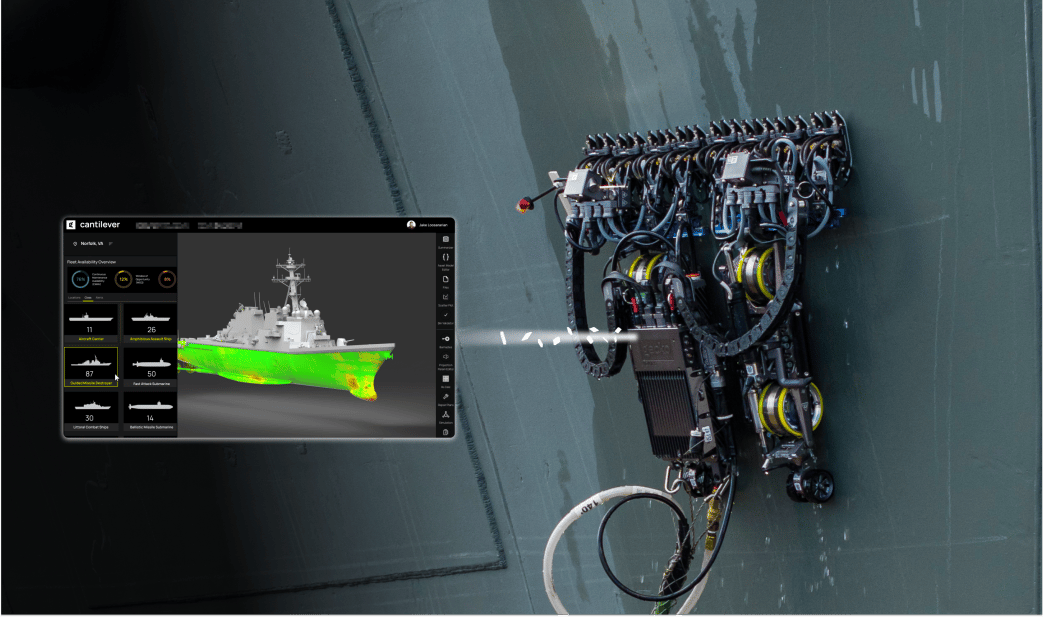
The U.S. Navy has inked its largest robotics deal yet as the military branch looks to use robots to keep up with its fleet maintenance. (image: Gecko Robotics)
Gecko Robotics, a Pittsburgh-based company that makes robots and sensors for inspecting large industrial assets, has signed a five-year IDIQ (indefinite delivery, indefinite quantity) deal with the U.S. Navy and U.S. General Services Administration (GSA). The deal starts with an initial $54M award and has a $71M ceiling. The Navy will use Gecko’s robots and sensors to monitor the status and health of the U.S. Navy’s assets and fleets of ships, starting with 18 ships in the U.S. Pacific Fleet. Gecko founder and CEO Jake Loosararian told TechCrunch that the company’s robots will crawl into every nook and cranny of the ships to create a detailed digital replica — sometimes called a “digital twin” — of each vessel. The company’s software will help the organization monitor the assets and recommend maintenance, trying to get ahead of problems before they arise, and reduce maintenance times and costs. (source: TechCrunch)
AeroVironment has acquired California drone maker Empirical Systems Aerospace (ESAero) for about $200M, strengthening its ability to design, prototype, and produce advanced unmanned aircraft systems (UAS) for defense applications. AeroVironment will integrate ESAero as a subsidiary within its Precision Strike and Defense Systems group, adding engineering and manufacturing facilities in San Luis Obispo, CA, to its portfolio of loitering munitions, missiles, and unmanned systems. The transaction was funded with roughly $160M in stock and the remainder in cash. A key part of the deal is ESAero’s expertise in electric and hybrid propulsion, rapid aerospace prototyping, and AS9100-certified UAS manufacturing, which AeroVironment says will help accelerate development from design to production. The acquisition builds on AeroVironment’s broader strategy of integrating innovation hubs into a cohesive suite of mission-critical solutions for defense customers. It follows the company’s roughly $4.1B acquisition of BlueHalo in 2025. (source: TheDefensePost)
Ondas, a leading provider of autonomous aerial and ground robot intelligence through its Ondas Autonomous Systems (OAS) business unit and private wireless solutions through Ondas Networks, and World View Enterprises, Inc. (“World View”), a leader in high-altitude balloon ISR and stratospheric remote sensing, announced that Ondas has made a $10M strategic investment in World View. The companies also announced they have entered into a partnership agreement that outlines a collaboration framework for the development of multi-domain and multi-modal intelligence, surveillance, and reconnaissance (ISR) solutions for commercial and defense customers. Under the partnership agreement, Ondas and World View will explore and advance integrated offerings that combine World View’s high-altitude, long-endurance stratospheric balloon systems with Ondas’ portfolio of unmanned aircraft systems (UAS) capabilities. The companies plan to evaluate joint solution architectures, priority mission applications, and potential go-to-market approaches serving customers across the U.S. Department of War (DoW), Department of Homeland Security (DHS), allied defense and homeland security organizations, and critical infrastructure operators. (source: Ondas)
Voyager Technologies was awarded a follow-on contract under NASA’s Expendable Launch Vehicle Integrated Support 3, or ELVIS 3, program through prime contractor a.i. solutions. The multi-million-dollar contract extends Voyager’s multiyear support of NASA’s Launch Services Program through the end of the government fiscal year. Under the contract, Voyager ensures launch vehicles and spacecraft are integrated and prepared for flight in accordance with NASA safety and mission assurance requirements. (source: Voyager)
Texas-based software-defined factory startup UNION announced a partnership with Hanwha Defense USA, the U.S. arm of the South Korean mega-prime, to speed up production of 155mm shells. The initial focus will be on metal parts and components, with a potential move into other areas, including energetics. On Hanwha’s side, they make the barrel, fuses, and other components to deliver a fully integrated munition, instead of the fragmented approach most other U.S. government-owned plants take to assembly. (source: Tectonic)
AI-powered machine gun turret startup Allen Control Systems (ACS) announced that it’s officially teaming up with drone giant Red Cat as part of their Futures Initiative to build their Bullfrog platform onto Red Cat’s unmanned surface vessels (USVs). (source: Tectonic)
Eric Trump and Donald Trump Jr., the president’s sons, are backing a new drone company that is vying to meet fresh demand from the Pentagon and fill a hole left by the administration’s ban on new Chinese drones in the U.S. Powerus, a drone roll-up company based in West Palm Beach, FL, is merging with a publicly traded golf-course holding company backed by the Trumps, Powerus executives said. The reverse merger will result in Powerus, which was formed last year, trading on the Nasdaq stock exchange in the coming months. (source: The Wall Street Journal)
French in-orbit servicing startup Infinite Orbits is on a buying streak. Less than one week after the company announced the purchase of Luxembourg autonomy startup LMO, Infinite Orbits (IO) announced the acquisition of UK-based Lúnasa Space—a company developing autonomous navigation tech for RPO and ISAM applications. The deal provides Infinite Orbits with a stronger technical backbone for future life-extension missions in orbit—most notably its GEO mission for SES in 2027—and gives the French company a foothold in the UK. (source: Payload)
Gallatin AI announced it has been awarded a contract under the Army Applications Laboratory's PORTAL (Predict, Optimize, Recommend, and Track for Adaptive Logistics) Direct to Phase II SBIR to develop its Navigator platform for Army units operating at multiple echelons. The 18-month Phase II effort will deliver a functional logistics planning prototype built on machine learning demand forecasting and modern optimization algorithms. Navigator analyzes courses of action near-instantly, helping sustainment planners overcome enemy interdiction, route denial, and environmental factors that make large-scale combat operations so difficult to sustain. The award directly supports two of the Department of War's six strategic priorities: Applied Artificial Intelligence and Contested Logistics Technologies. (source: PR Newswire)
WHAT I’M CONSUMING (AND ENJOYING!)
💡 Travis Kalanick renamed his company to Atoms, expanded its portfolio into the mining and transport industries, and included a vision statement outlining the digitization of the physical world, which includes robots on wheels.
🗒 I get a lot of “what about San Diego” when I do my hard tech map. Here’s a great resource. It’s a curated list of 50+ hardtech companies in San Diego, compiled by Neal Bloom’s Rising Tide Partners.
⚙️ Cantos’ Grant Gregory on why hardware is hard and what he looks for in a founder.
📈 “Faster, Better, Cheaper (FBC).” Per Aspera gives its take on how we turn FBC loose on an America hungry to make things again. How do we scale? What does rebuilding supply chains mean? And how do we train people and adopt technology fast enough for it to actually matter?
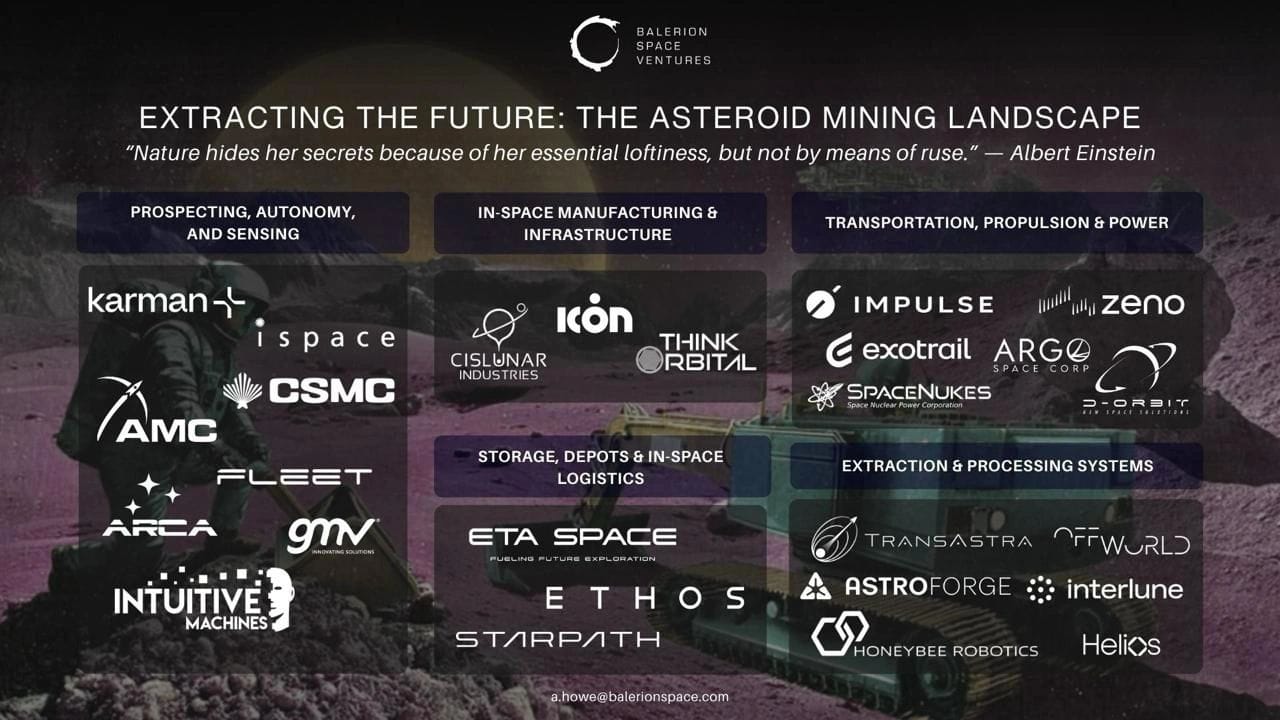
image: Balerion Space Ventures
🖌Another Space Dirt, another Balerion Space Ventures (BSV) graphic. From BSV partner Phil Scully, “The Asteroid Mining Gold Rush Is Coming. Here's Who's Building the Picks and Shovels. Most people hear "asteroid mining" and think science fiction. We think it's the next trillion-dollar value chain. Aiden Howe mapped the asteroid mining landscape across five critical layers.”
💼 Defense News’ 2026 Tech Disruptors list has been released. It’s composed of top tech leaders shaping defense technology, with an emphasis on operational impact, disruption, strategic influence, program scale, and recency of achievements. Disruptors are selected based on their contributions to the military and defense space.
🕵️♂️ This Bloomberg piece notes that former CIA officers are increasingly launching defense technology startups, aiming to capitalize on a proposed surge in the U.S. defense budget and the high demand for advanced surveillance, AI, and cyber capabilities.
🚀 Jordan Taylor deep-dives into rockets: Why Rockets are Hard.
🇺🇸 Just before the American Dynamism Summit kicked off, a16z’s David Ulevitch explained why American Dynamism is important. This quote is a good wakeup call: The U.S. once led in 60 of the 64 most critical technologies. Today, we have almost entirely lost that lead, with China now leading in 57 and the U.S. in only 7 technologies.
HOW I CAN HELP YOU
Here are 3* ways I can help when the time is right:
Find a new home for your growing business. You're scaling fast, and you don't have time to become a CRE expert. I do this every day.
Sublease your space. Outgrown your office, but don't want to pay two rents? I'll help you find a subtenant.
Negotiate your lease renewal. Want to make sure you’re getting a fair deal from your Landlord? In my experience, you can never be too sure. Start 12 months out, so you're not scrambling at the last minute.
Strong references available. Let's talk.
*Not an exhaustive list 💪
Thanks for reading.
If you’d like your office and/or manufacturing space or business profiled - or even your city! - let me know. It’s always fun to explore and share the different components of the hard tech industry.
Erik Stiebel
Founder and Vice President
CA DRE License #02080746
424.241.4795 | [email protected]
Follow me on 𝕏
Reply